Author Archives: Sarah
Day 2 – Gervais to Monmouth, OR

A lovely trike with flowers at Graham and Peggy's house - note the apple tree in the background!
This was supposed to be a rainy day, which was going to be quite miserable for riding bicycles. I awoke to the sound of rain outside our window, but the sun hadn’t risen yet so I fell back asleep, thinking about what a wet start we were going to have. When Dallas and I finally did wake up for real, the rain had stopped and blue skies were visible behind the dissipating clouds. The weather forecast had gone from 80% to 0% chance of rain overnight. Dallas and I are seriously the luckiest people ever.

Troy's bike shop in Salem
We got back on the road about an hour earlier than we had started the day before, hopeful to make it about 60 miles. Twenty miles and almost 2 hours later, we were in Salem. We stopped at the bike shop owned by Troy, Graham and Peggy’s son – and we arrived just as the sky darkened and started to spit rain at us. Troy wasn’t there, but the other employees were friendly and said we could leave our bikes inside while we went to get lunch. By the time we had finished eating, the sky was blue again and the sun was shining.

Rainbow!
Our next stop came just 13-14 miles later. Exhausted from the headwind and rolling hills, we took a short detour into the town of Independence to pick up some food at the market. Just a block before the market, we passed a cafe advertising pies and ice-cream. This was just what we needed. The man working there came outside and watched as we were locking our bikes together as if we were crazy. “Nobody ever steals in Independence. They’d get shot. The cops here are good, and everyone knows each other. No one steals.” Still, we weren’t going to risk losing our new bikes! No sooner than stepping inside, the sky opened up for the third time that day and poured rain onto our bikes. The man, who called himself Dutch, asked how he could make our perfect day any better. He explained that the kitchen had closed two hours ago, yet their Open sign was still on and there were three people sitting at a table drinking coffee. He then ignored all of our attempts to say we just wanted dessert while he went on listing the sandwiches and quiches and salads that he could still make for us (it seemed that the only thing out of the question was the soup, which was apparently delicious). Once we could finally get a word in, we managed to order lattes and pie (ice-cream came with the pie at no extra charge!). As we were finishing up our pie, Dutch came over to our table and told the story of the historical town of Independence, which is the end of the Oregon Trail. Then, he seamlessly interluded into a discussion on natural disasters and how the whole west coast from Crescent City to Vancouver is going to be destroyed by earthquakes, volcanoes and tsunamis. Independence is the epicenter of the fault subduction zone, but Dutch isn’t concerned. He’s prepared.

It was after 4pm when we finally said goodbye to Dutch and left his 2EZ Cafe. The sun was shining again, but daylight time was limited. Until just before Independence, we had been following the Willamette Valley Scenic Bikeway, but we decided to take a different route from here and try to cut 7 miles out of the trip. This brings us down the opposite side of the Willamette River and through more farmland. The scenery has been good so far, and the hills and headwinds haven’t been any worse than they were before we deviated from the bikeway. Amongst all the farms and private property, we lucked out again today and found a small spot of state park land with a trailhead. There was a no camping sign, and there was a bar across the entrance to the parking lot, but we were able to slide in with our bikes and find the perfect spot to pitch our tent just as the sun set.
Day 1 – Back in the Saddle Again

Despite two days of false hopes, we were finally, definitely ready to leave on Sunday morning, which happens to be exactly two years to the day that Dallas had initially left Portland before ending up in New Orleans. Still, it was almost noon when we finally rolled away from the house we were staying at in Portland. My loaded bike seemed incredibly heavy, and my legs felt sensitive to even the slightest incline. We were both out of practice after not having toured in so long, so it took a few miles to gain our balance and momentum. That momentum was killed as we followed fallen lifesavers and other pieces of crushed candy up the steep hill to Dallas’s mom’s house in Oregon City.

Riding the Champoeg bike path
After a brief stop in Oregon City, Dallas and I continued to Champoeg (pronounced ‘Shampooey’) State Park – the start of the Willamette Valley Scenic Bikeway, which would take us south to Eugene. At the park, while we shared an apple with almond butter, a park ranger approached and asked if we were camping there. We still had about two hours of daylight, so he pointed us in the direction towards the next campground, about 20 miles down the scenic bikeway.

It seemed like a lot of people were burning things outside today, and the wind kept blowing smoke to our senses before we could see the source of all the fires. We rode through miles of farmland rich with fall crops like apple and hazelnut trees, corn, and pumpkins. We still had just under ten miles to go when the sun touched the horizon.
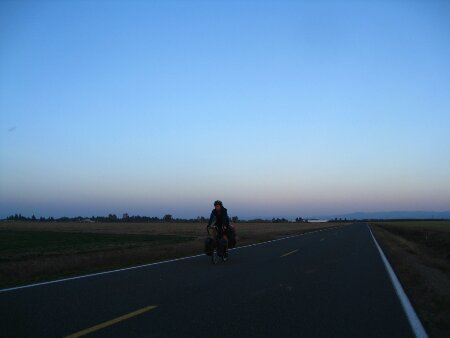
As we pulled over to put our lights on, a truck pulled over to ask us about our bike tour. Back on the road, just a short distance beyond this and around a corner, the truck was pulled over again. A guy got out as we approached and offered us his parent’s apartment behind their house for us to spend the night. It was half as far away as the campground and included a bed and shower. We eagerly accepted the offer, and they gave us directions to their home.
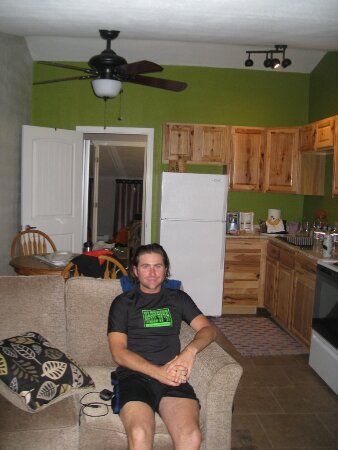
This is MUCH more luxurious than our tent - thanks, Peggy and Graham!
Graham and Peggy were waiting for us when we pulled up to the garage, where their beautiful apartment is attached. They showed us around and told us to eat or drink whatever we found in the fridge. We are so grateful for such generous people who open their homes up to us, and we both hope to return the favor some day.
Distance covered today was just under 50 miles (not bad for starting at noon).
New (used) bikes for our next adventure
Back in Portland, Dallas and I spent a few days recovering from our travels from Alaska. We needed to get moving though, before the weather turned cold and rainy. It was apparently already too late to miss the rain, so after 2 rest days, we started to get serious about our next move. Dallas purchased an almost new Kona Honkytonk from our friend Alyssa, and I found an excellent deal on a GT Wheels 4 Life Peace tour bike on Craigslist. The former owner of my new steed had just finished riding across the US with it – you can see her blog here: www.missionusa2013.blogspot.com
On Friday, Dallas caught up with family in Oregon City while I ran with our friend Kelly in Forest Park. I spent that weekend testing my bike out on some of John Benenate’s team rides. It’s heavy compared to everyone’s road bikes, but it will definitely get me out of Portland. After spending Saturday and Sunday cycling in the rain, Dallas joined me for Tuesday and Wednesday evening group runs organized by other Skora ambassadors. There’s definitely enough resources to stay active all week in Portland.
My plan was to wait for a few sunny days in a row (which could be weeks here), and get as far south as possible before the rain hits again. We got lucky on Thursday afternoon when the sun came out (and we got to see our friend Kristina, from Sockeye, who had just arrived in Portland the night before).

Hoping to leave Friday, we hurried to get everything we needed together for another long bike tour. Halfway through the day, we decided we wouldn’t be ready and would leave on Saturday instead. Saturday morning came, and we still had a few last minute things to pack and adjust. By Saturday afternoon, we were still not quite ready. Hopefully we haven’t wasted our only two sunny days in Portland. We definitely plan on biking out Sunday morning!
The plan is to head south as far as Eugene together. Then, I may cut west to the coast and ride down the Pacific Coast Highway. Dallas is planning to continue towards Crater Lake (hopefully the National Park will be open again by the time he gets there) and south to visit his dad in Ashland before meeting up with me again in San Francisco. The goal is to get to San Francisco by October 19th. Keep checking back for more frequent updates along the way!
On the Road Again

Dallas and I were able to take advantage of a deal on a rental car to drive from Skagway to Anchorage, from where we found cheap flights to Seattle. Since it’s so hard to get to Alaska, we figured we should explore some more of the state before leaving entirely. We left Skagway on a Wednesday and made stops in Carcross and Whitehorse before heading Northwest on the ALCAN. Once over the White Pass summit and into Canada, we enjoyed clear skies and roads lined with trees of autumn colors, ranging from dark green to bright yellow and orange. The Yukon is SO beautiful, but that first night of camping was FREEZING!

We drove on through places with names like Destruction Bay and Beaver Creek, and then crossed back into Alaska on Thursday afternoon, stopping in Tok and North Pole en route to Fairbanks. We were never far from a picturesque view of mountains, most of which were topped with snow. It actually started snowing on us while passing through Tok. In Fairbanks, Dallas surprised me and splurged on a hotel so we could sleep well in a warm bed. I had offered numerous times to drive, but he insisted on staying behind the wheel.

We took off from Fairbanks relatively early on Friday morning. Both of us had developed an aversion to big cities after living in Skagway all summer, and we were eager to continue on through this one. The day was mainly cloudy, and the enormous mountains surrounding us were mostly invisible. We really wanted to see Denali, but the road is usually only open to personal vehicle for the first 15 miles. A few days ago, they had opened the road up as far as mile 30 (weather dependent). We were fortunate enough to drive twice as far than most tourists who visit during the height of the summer season. Adding to our good fortune, the sun started peaking out in the distance behind the mountains as we neared the 30-mile mark. We paused at this lookout spot to eat some crackers with tuna and avocado, and by the time we were ready to move on the whole sky had transformed to clear blue, and all of the clouds were gone. At every moment on the way up the road, we were both stopping constantly to take photos. On the way down it was even more awe-inspiring.

The sun came out!
The only thing both of us would change next time we visit Denali is our mode of transportation. It was warm and effortless to drive through, but it would have been so much better had we been on bicycles. Throughout our road trip we had to make frequent stops to get out and stretch our legs, run around scenic overlooks, do pushups, yoga, etc. On a bicycle we wouldn’t feel the need to stop to move our bodies, and we could take in all the beautiful scenery without a pane of glass separating us from all of this beauty and fresh air. Another benefit to being on a bike is that we would be permitted to ride the entire 92-mile road through Denali National Park, and not just 15 or 30 miles. The only other option to get that far into the park would be from the seat of a tan-colored school bus filled with other tourists.

Jumping around while out of the car
Continuing south from Denali as the sun disappeared behind the mountains, we saw two moose playing in one of the creeks off the highway. Eventually, we made our way to Talkeetna, a small town best known for being the launching spot for climbers wishing to summit Mt. McKinley. The only place that was open was the Fairview Inn – an historic pub with accommodations on the second floor. The room we were given was filled with nothing but a bed, dresser, and noise from the bar downstairs, but the price was right. Dallas and I each enjoyed a beer from the Denali Brewing Company (located next door to the Fairview Inn) before heading upstairs to our room and falling sound asleep before last call.
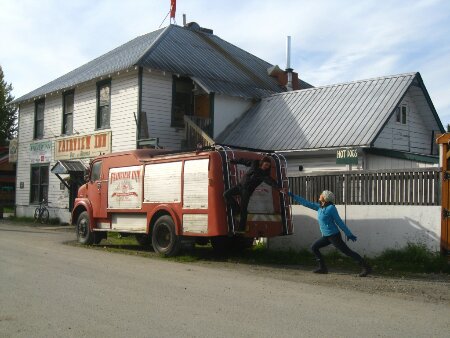
Posing in front of the historic Fairview Inn
On Saturday, we walked around Talkeetna, sampling coffee and baked goods from several cafes before heading towards Anchorage. We only stopped briefly in Anchorage to have sushi at Ronnie’s at the recommendation of Alex, a native Alaskan who I had worked with at Columbia in Portland. The rolls were so big, we took enough sushi with us for dinner later that night. Also at Alex’s suggestion, we continued on to Homer, instead of Seward, to where we had originally considered driving. Both towns are at the end of opposite roads on the Kenai Peninsula. Shortly after the sun went down it started drizzling, and we decided to stop and pitch our tent at a campground in Ninilchik. Our luck came through again when we woke up on Sunday morning to clear blue skies.
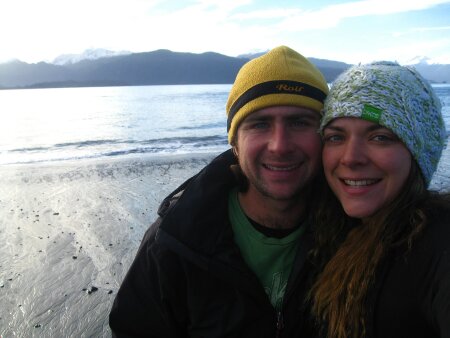
The drive out to Homer was beautiful, with mountain views on the other side of the bay. It was amazing how green the trees still were down here, while they were all yellow and orange up in Fairbanks and the Yukon. We were able to run 5 or 6 miles along the Homestead Trail after lounging at one of the only cafes still open for the winter season.

Dallas running along the Homestead Trail in Homer
To be honest, the Homestead Trail left for much to be desired. The parking area was across the street and a block away from where we entered the trail. No big deal, once we found the trail. However, we were running up to our eyeballs in a field of fireweed that had turned to cotton, getting white bits of the plant all over our black shirts. Still, not that much of a problem. But the long grass around the trail covered up the surface, which was muddy and full of divots. Not being able to see our footing, I feared that I would twist an ankle or slip in the mud. Our fears grew worse when we accidentally stumbled upon the bottom half of what appeared to be a horse’s front leg. It looked like the leg had been sawn clean off right below the first joint. In addition to all this, the trail was inconsistent and very ambiguous. There were forks, dead ends, clearings (one of which we interrupted a steamy rendezvous between two ATVers), and eventually we had to take a road for quite a distance to get back to the car. None of our issues with Homestead seemed to bother the two big dogs who took joy in chasing us down parts of the trail, romping carefree circles around us through the muck before disappearing amongst the fireweed.
Any chance we got to move around in between long hours of sitting in the car felt great, and the weather could not have been better for us this time. We had to return the car the next morning, so we couldn’t spend the night on the Kenai. As we drove back up to Anchorage, the setting sun lit the sky behind us with shades of pink and orange. It started raining and snowing as we drove North into the darkness.
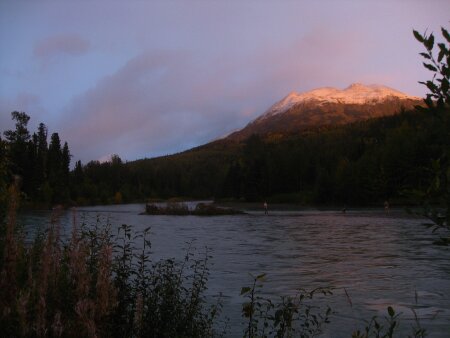
We totalled over 1600 miles on our Alaskan road trip adventure, yet we still covered less than half of the state. We could have driven more than halfway across the continental US. Another thing I find interesting is that Rhode Island, being the smallest state in the US, has more residents than Alaska. It is such a vast and wild land, empty when it comes to people, but so full of wildlife, mountains, trees, plants, water, and beauty.
The Chilkoot Trail
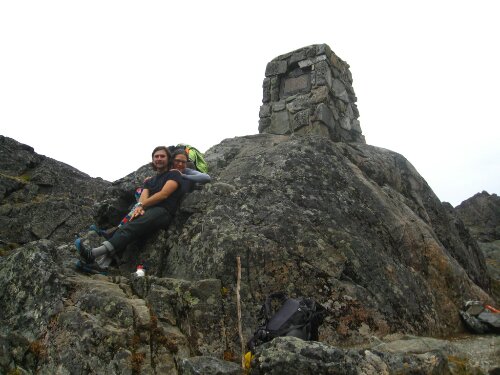
Dallas and I take a break at the top of the Golden Staircase after summiting the Chilkoot Trail
The weekend before we left Skagway, we hiked the historic Chilkoot Trail. This is a 33 mile long trail that was an established trading route for Tlingit natives, but was famously used by thousands of stampeders during the Klondike Gold Rush in 1898-1900. We were lucky enough to get 3 days of dry weather for our hike – probably the only three days without rain for over a month. June and July had been unseasonably warm and dry for Southeast Alaska, but after the first week of August we had started experiencing the more typical mist, rain, fog and cool weather on a daily basis.

Bear prints in the mud near the beginning of the Chilkoot
The most challenging section of the Chilkoot is a short stretch called the golden staircase, which rises more than 1000 feet in less than half a mile. I was in no way prepared for how rugged the climb would be, and for a few terrifying moments, I thought the weight of my backpack would throw me off balance to my demise. Once over the summit, the Canadian side was beautiful with incredible views of deep blue and turquoise lakes.

Looking out over the Canadian side from the summit
My favorite section was hiking along the gorge between Deep Lake and Lindeman City.

The gorge between Deep Lake and Lindeman City

View from the cabin we stayed in at Lindeman City
On the third day, we made it to Lake Bennett, where the train picks up hikers during the summer season. Since the last train came at the end of August, we had to hike 8 miles along the tracks back to the Klondike Highway, where we tried hitchhiking from Log Cabin. After 20 minutes of waiting at Log Cabin and growing colder in the increasing winds, we started walking towards Fraser, where the Canadian Customs Office is located. Only three cars passed within an hour of walking, including Officer Brown (the strictest of the US Customs officers). The third truck picked us up, but only took us the remaining mile or two to Fraser, where we were able to use a phone and call our friends to pick us up.

Walking the tracks from Lake Bennett to Log Cabin
Last days in Skagway
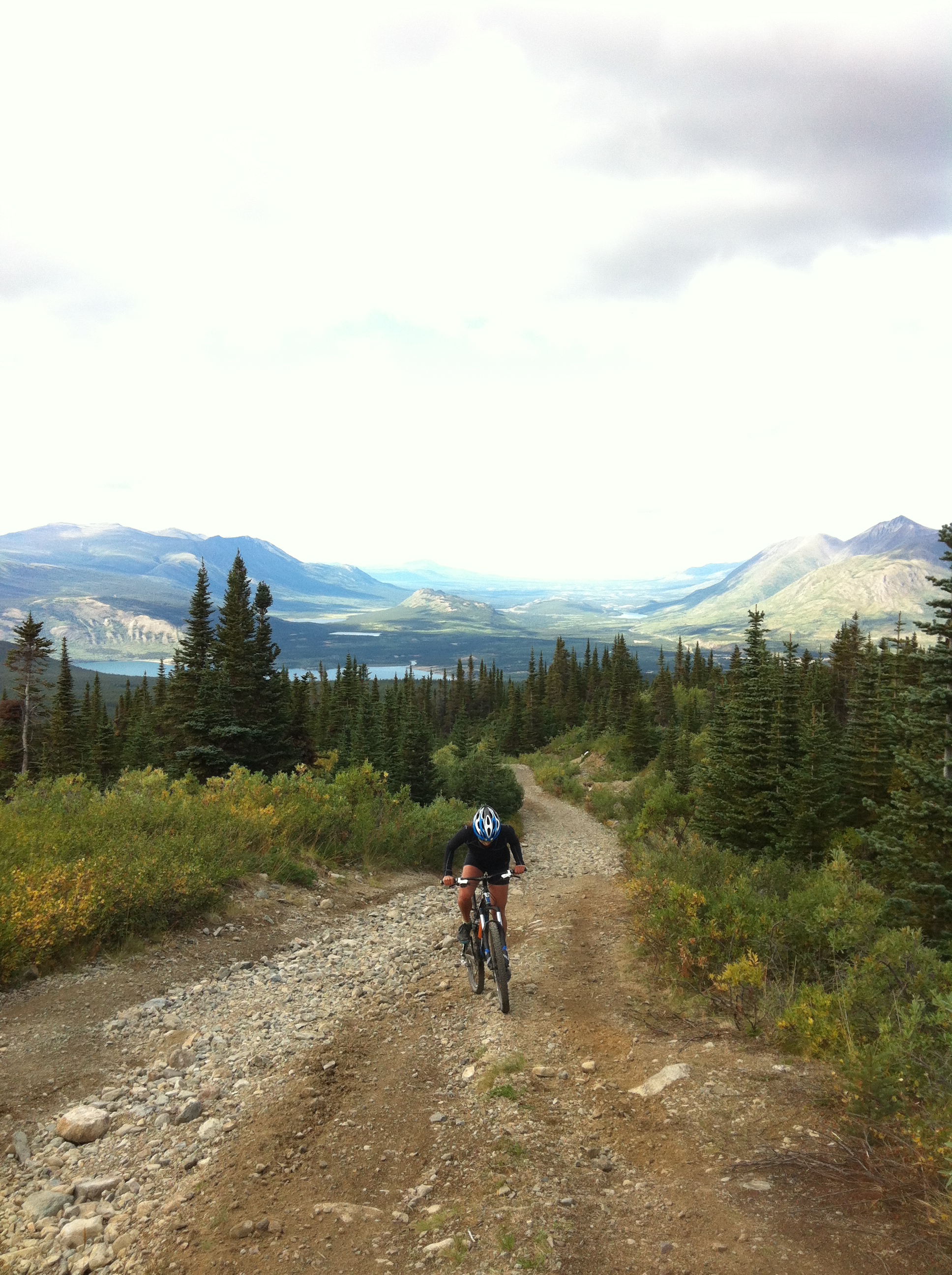
Biking up Montana Mountain in Carcross, YT
Dallas and I decided to extend our stay in Skagway by two weeks, so we could run in the Klondike Road Relay, take advantage of an extra pay period, and of course spend a little more time with the wonderful friends we made while living there. Working as a bike guide could be terrifying at times – trusting cruise ship vacationers to navigate themselves down the White Pass on mountain bikes may be less physically demanding, but is much more stressful than pulling people around in a pedicab. If I work as a bike guide again, I hope the clientele are limited to experienced cyclists who are physically and mentally prepared to do multi-day bicycle touring. Still, this job was a worthwhile and enjoyable experience.
I have never lived with such close access to trails where I could lose myself in nature so easily. Just a 5 minute walk from home could take me to the Dewey Lake trail system, where there are miles of hiking trails. We were also just a 65 mile drive (or bike ride) from Carcross, in the Yukon, where it is always sunny and there are numerous mountain biking trails on Montana Mountain.
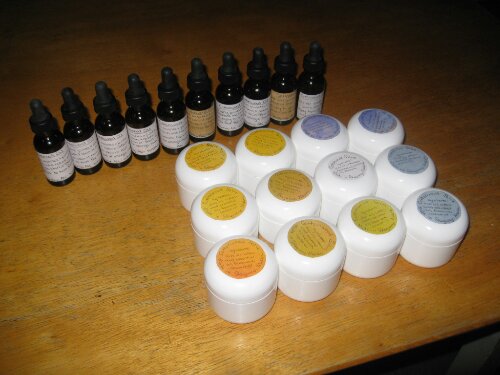
Homemade cottonwood oil and salve, bottled just a day after Skagway’s last farmer’s market of the season
From what we were able to forage locally, we made things like dandelion salad, fireweed syrup, blueberry crisp, cranberry-poppy seed muffins, rose water (which I used to make baklava), and cottonwood oil/salve. I only wish I could have finished bottling the cottonwood oil and salve before the last farmer’s market. Cottonwood oil has medicinal properties and can be used as an anti-inflammatory, analgesic, and anti-microbial. As a massage oil, it can be used to ease sore muscles or joints, and it can also be used to heal chapped or scraped skin. If anyone would like to buy one, I will send you a 1oz bottle of oil for $12 or 2oz jar of salve for $15 – just e-mail me or leave a comment on this post.
Looking back at our time in Skagway, both of us are very glad that we decided to spend our summer there. We were able to make great new friends, occupy our free time with a variety of outdoor activities including hiking, running and mountain biking, and we learned so much about the environment and history of the area. Hopefully our friendships will continue far beyond this summer, and we will be able to carry what we learned to whatever awaits us in our next adventure.
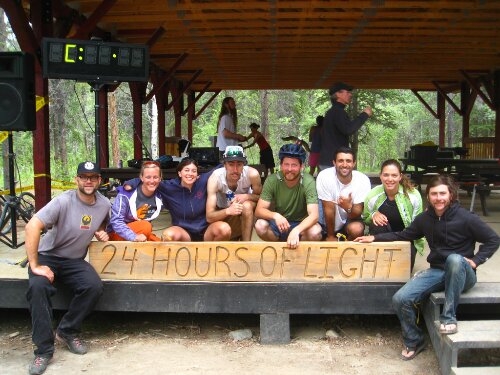
The Rockeye Sockeye Robots team at the end of the 24 hours of light mountain bike relay race in Whitehorse

Me, Scott, Ryan, Dillon, Kristin and Zabeth climbed up to Goat Lake on the no-ship day in July
Klondike Road Relay
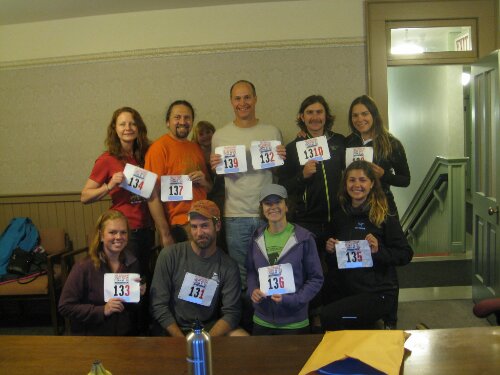
The Klondike Road Relay is a running race that runs from Skagway to Whitehorse during the first weekend of September. It started on a Friday evening, and our team ran all night up the Klondike Highway before crossing the finish line, 110 miles later, in downtown Whitehorse Saturday afternoon. Our friend Jaime connected us to the National Park Service team, where I ran leg 8 and Dallas ran leg 10 (the anchor leg). Each leg was anywhere from 7 or 8 miles to 16 miles long. The first two legs run up the White Pass (the reverse of our Sockeye Cycle Klondike bike tours), gaining 3292 feet of elevation in less than 15 miles. Dallas and I each ran between 12 and 13 miles for our respective legs. Our team was able to knock off more than forty minutes from their previous year’s time!

Guide Training
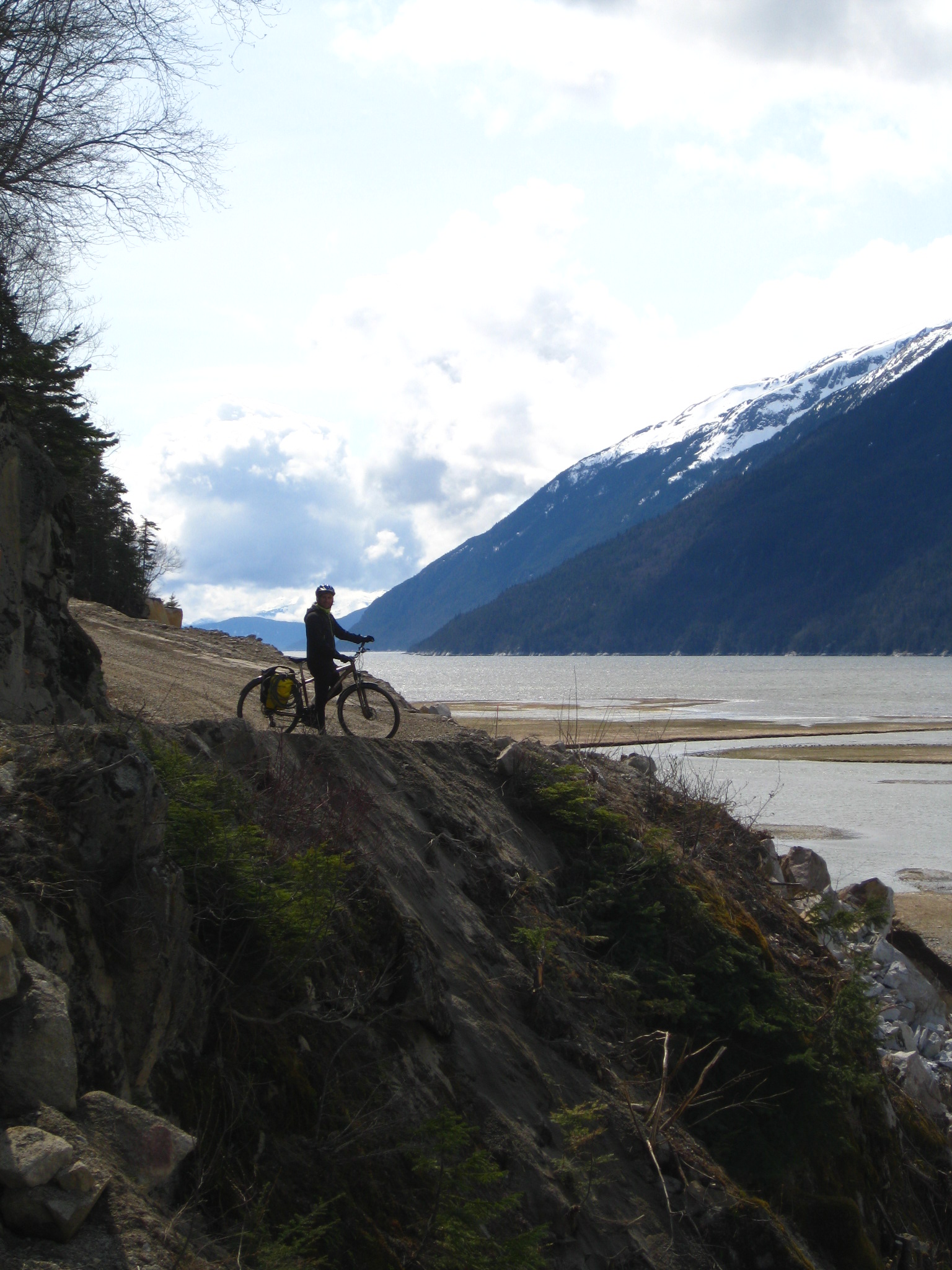
riding back from camping in Dyea
Training started on May 1st, and for the first week or so, all of us learned an incredible amount about Skagway, Coastal Temperate Rainforests, local flora and fauna, and glaciers, among other things. When we weren’t actively training to be bicycle tour guides, we were participating in other activities aimed at welcoming and orienting us for our first summer in Skagway. We went camping in Dyea, a town that began as a small summer fishing camp for the local Tlingits, boomed to about 20,000 people at the height of the gold rush, and then became a ghost town shortly after completion of construction of the railroad from Skagway to Dawson City. We hiked some of the Chilkoot Trail and rafted down the Taiya river with another tour company. We went on a bike ride through the Northwest sliver of British Columbia and into the Yukon Territory to Carcross. We were given an exam with 30 questions to answer in detail and return a week later. When possible, we ran and explored some of the nearby trails in an attempt to train for the upcoming Skagway Marathon. Most of the trails were still too icy or covered with snow. Dallas and I had very little time to relax, and practically no time to write or talk to friends and family back home.

Me, Zabeth, Kristina, Kelly and Kyle cycling into the Yukon Territory
Training has finally ceased, and all of us new guides have been slowly easing into the routine. Cruise ships are starting to dock regularly at one of the three docks. One amazing thing about this is that Skagway sits right at the end of the Lynn Canal, which is the deepest and longest fjord in North America. The mountains around here, which reach heights of 7000 feet, rise right up from the sea, and the 1800ft deep canal allows cruise ships to pull right up to the docks. In Newport, cruise ships would anchor in the middle of the bay and people would be shuttled to the shore on small boats called tenders. At the peak of tourism season, we will be getting 4-6 cruise ships in town daily, with fewer on the weekends. The town, which only has about 800 residents year-round and 2000 during the summer, increases 10-fold during the day while all the cruise ship tourists are walking about. While Dallas and I have mixed feelings about them, these cruise ships are vital to Skagway’s economy.
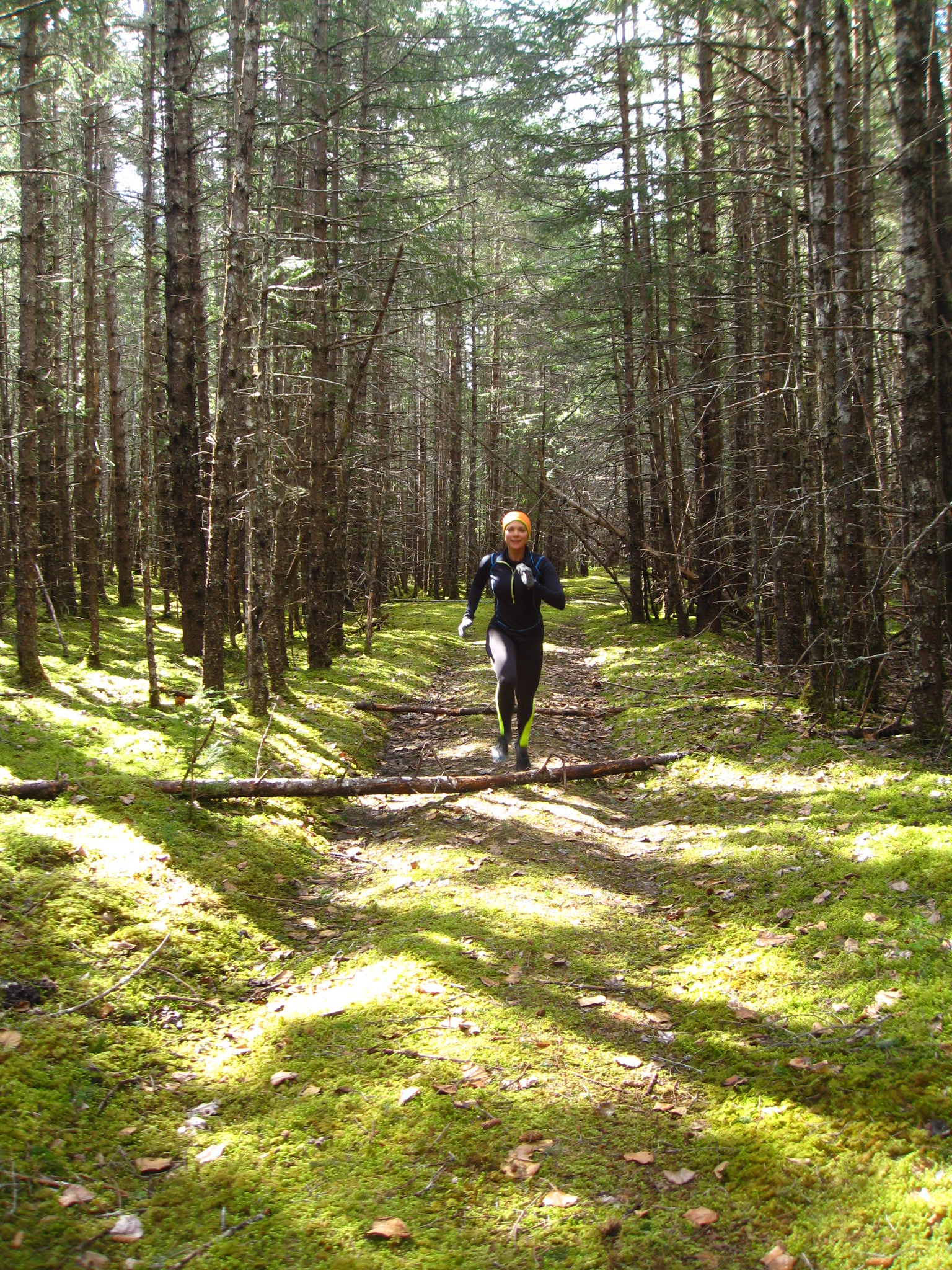
running in Dyea
One great thing about living here is the amount of outdoor activities and available hiking trails just out our back door. The local backcountry outfitter’s store has a summer trail challenge, and I’m excited to hike or run all 12 of the trails on the list. The most challenging will be the historic Chilkoot Trail, which in its entirety is 33 miles long and climbs 3500 feet in elevation. It was once a Tlingit trading route, where natives would hike to trade their fish (Hooligan) oils with the Tagish natives of the interior for furs to stay warm and red cedar to build kayaks. When gold was found outside of Dawson City in 1896, people flocked to Dyea to hike this same trail. The trail ends at Lake Bennett, where people would then have to build a boat to float another 500 miles up the Yukon River to where the gold was found.

hiking along the Chilkoot Trail with (top to bottom) Holly, Kelly, Zabeth, Dallas, Kristina and Kyle
Another great thing about this region is the air quality. Lichens grow in abundance here, which is a true testament to the cleanliness of the air since they receive their nutrients from the air and are so sensitive to air pollution. Also, bicycling is a very common form of transportation, probably because the town is only 5 blocks wide and 22 blocks long. For a school that has only 60-70 people (k-12), there are more bike racks than the train station in Providence. This certainly helps the air quality. Today, while driving up to the summit for the start of one of our tours, we passed a group of high school students from White Horse, who were cycling back. They were in the midst of a 15 mile uphill stretch along the Klondike Highway that climbs to 3292ft in elevation from sea level. I was impressed (and a little jealous).

from a trail high above, Dallas watches the departure of a cruise ship
The only negative thing I can say about living in SE Alaska is that because we are so isolated, our food is expensive. Once a week, a barge comes in with all of the town’s supplies for the week. Groceries are not only expensive, but by the end of the week there is really not much to choose from. Dallas and I ordered some dry goods from Amazon, but produce and dairy are tough to come by without a high cost. Because of shipping costs, pretty much everything is pricier by at least 25 cents per pound. I’m looking forward to June and July, when we start getting more edible plants in the forest. Since learning about all of these berries, mushrooms, spruce tips and other edibles, my roommates and I plan to forage as much as possible in the upcoming months.
Arriving in Skagway
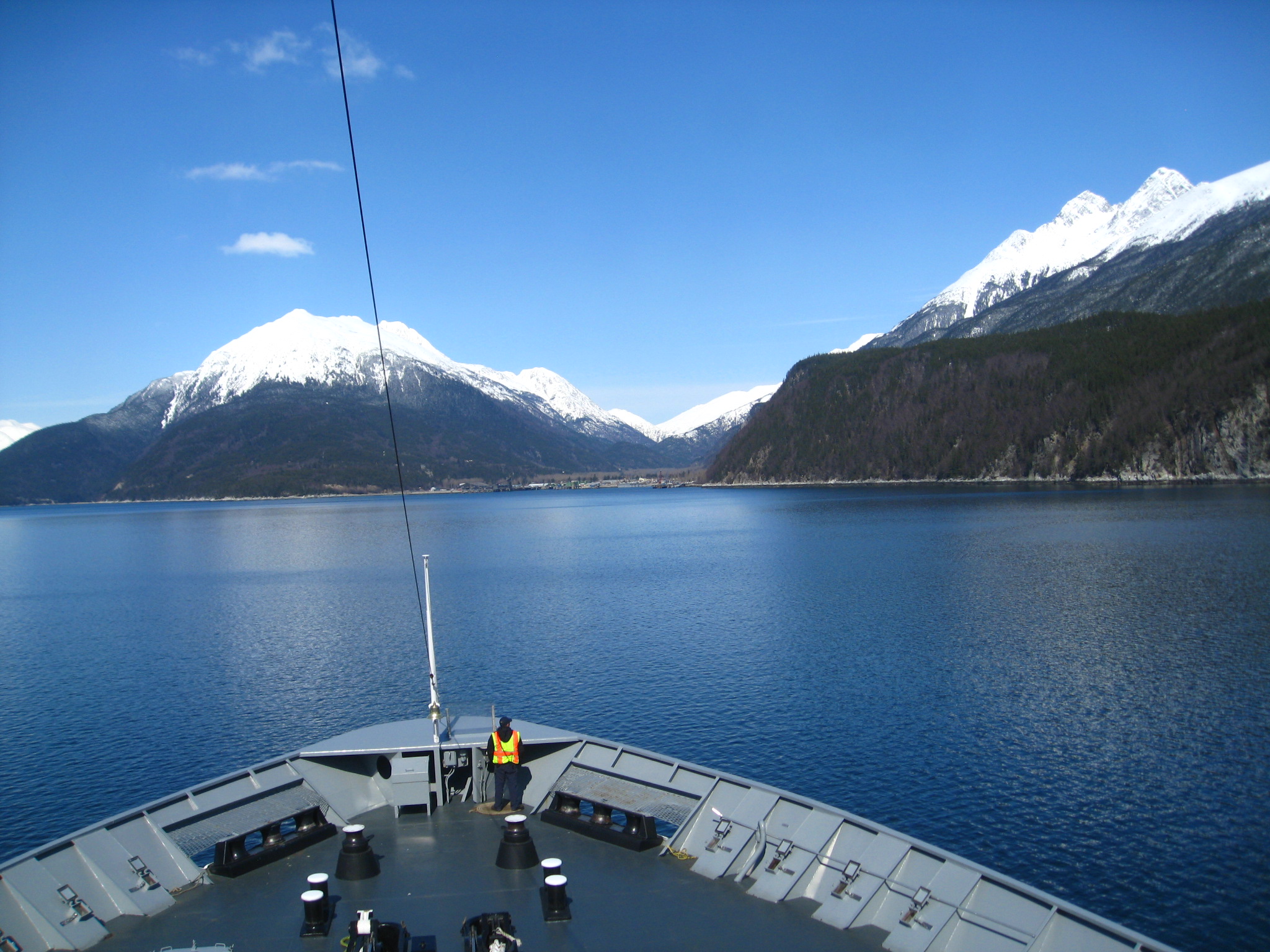
View from the ferry between Juneau and Skagway
We were both so tired, Dallas and I didn’t talk to anyone on the ferry. I was hoping to check out Haines, since the ferry was stopping there for two hours and Christy had told us it was a nice town, but when the ferry docked, I read a road sign pointing 4 miles to Haines. With nothing of interest within walking distance during our short layover, I went back to sleep on the bench next to Dallas. Neither of us were fully awake to appreciate the grandeur view for more than a few minutes before drifting off again, and I didn’t fully wake up until we were a few minutes from landing in Skagway, our destination for the summer.

Scott, Dillon, Kristina, Kellee and Zabeth – some of our fellow guides and housemates for the summer
Dustin and Scott greeted us when we stepped off the boat, and 4 other new guides who had been on the same ferry joined us a few minutes later. We all managed to load our bags into the Sockeye Cycle Van, and Dustin drove our belongings to the house while Scott led the rest of us by foot. It was only a few blocks to the shop, and walking felt good after lounging around on the ferry for 7 hours (three of the other guides had boarded the ferry in Bellingham, and had been on board for 4 days).

View of Smugglers Cove from Yakutania Point
Although it was clear and sunny that day, the announcement of an avalanche having recently blocked the white passage to the Yukon (pretty much the only way out of Skagway by land) reminded us that it was still very much winter in Alaska. Scott, the shop manager who had previously been a mechanic for a tour company in Italy, provided us with numerous and entertaining stories. He had arrived three weeks earlier and told us about his first day and days leading up to now, when it seemed he was finally able to talk to some other people who were seeing Skagway for the first time. I think we all shared his wonder in what we’ve gotten ourselves into here.
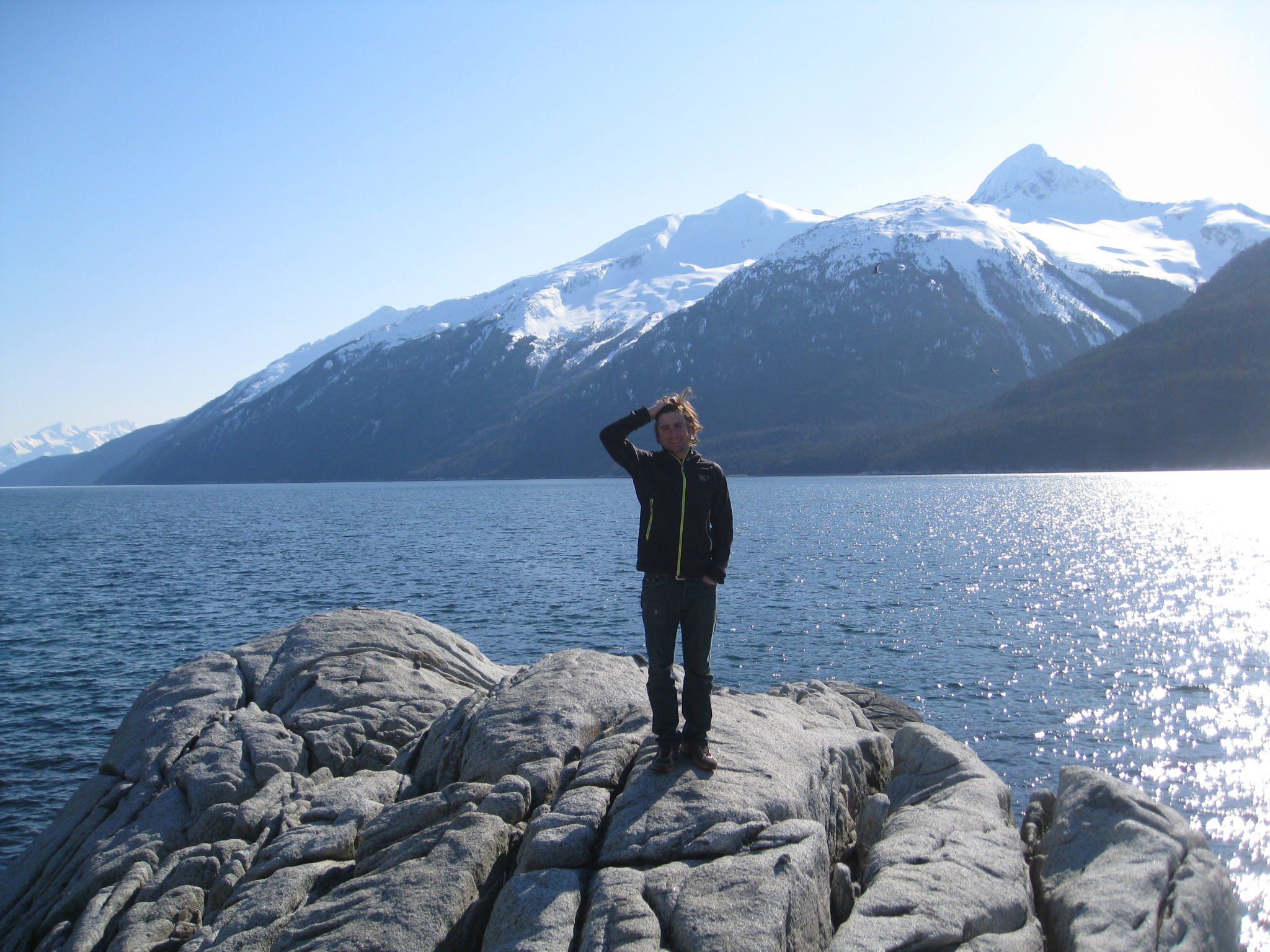
Dallas, standing at Yakutania Point on the day of our arrival in Skagway
The owner of the company, Thom, greeted us when we arrived at our new summer home, the two stories above the Sockeye Cycle bike shop. Then he hurried off to drive to Whitehorse, the nearest city, to buy supplies for the house and our welcome barbecue. Because of the avalanche, he had to take an alternate route to Whitehorse, and it was uncertain if he would even make it back the next day for the barbecue.
Dallas and I will be sharing this space for the next four months with 10 other guides.
Juneau
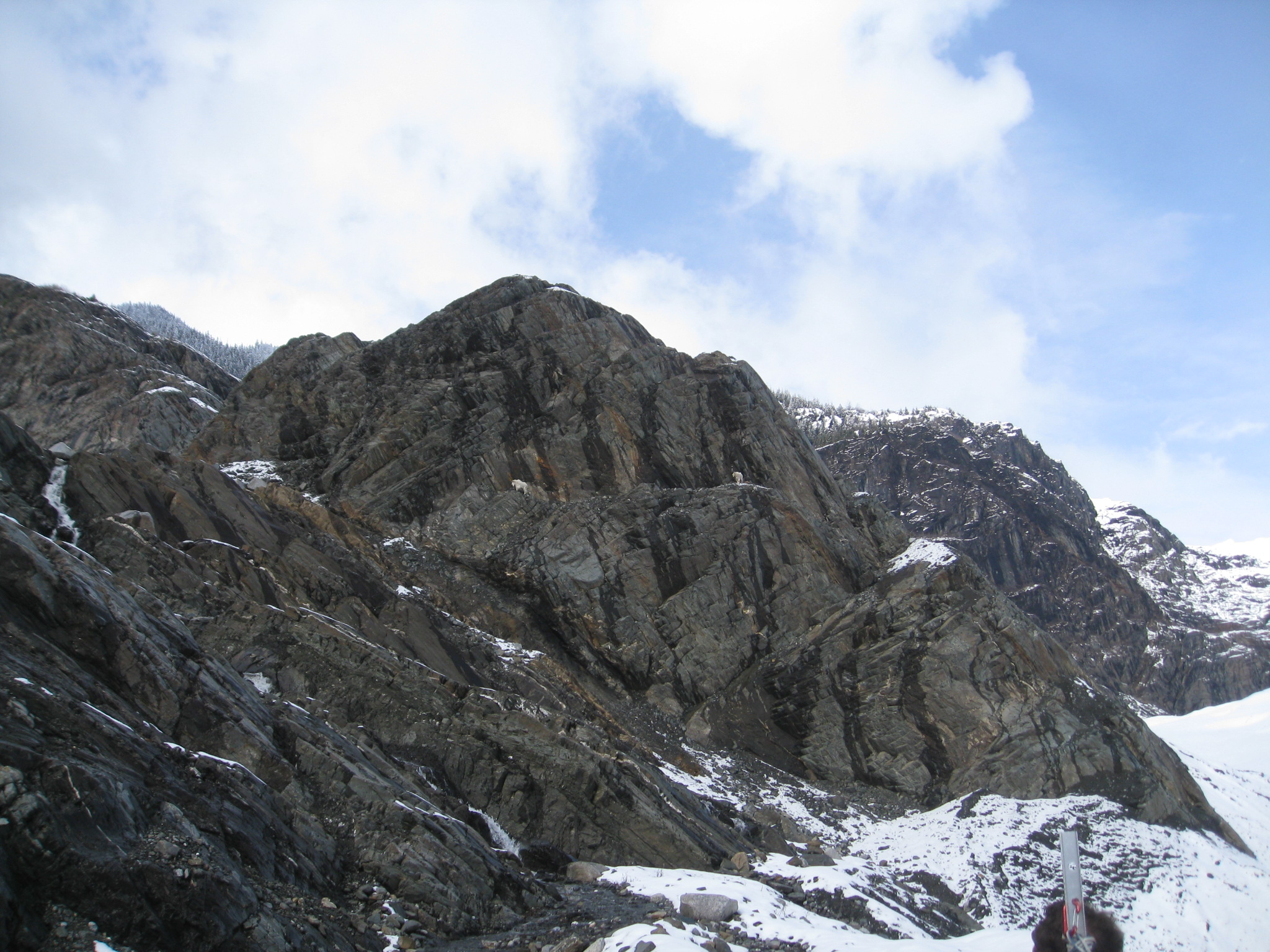
Can you spot the mountain goats?
After an unexpected stop in Ketchikan to exchange a few passengers, our flight landed in Juneau about thirty minutes late on Saturday night. Couchsurfers Christy and Jason had offered to host us at their home on Douglas Island, and they picked us up at the airport in an old Subaru Outback (perfect for the conditions, which were wet and slushy at the time).
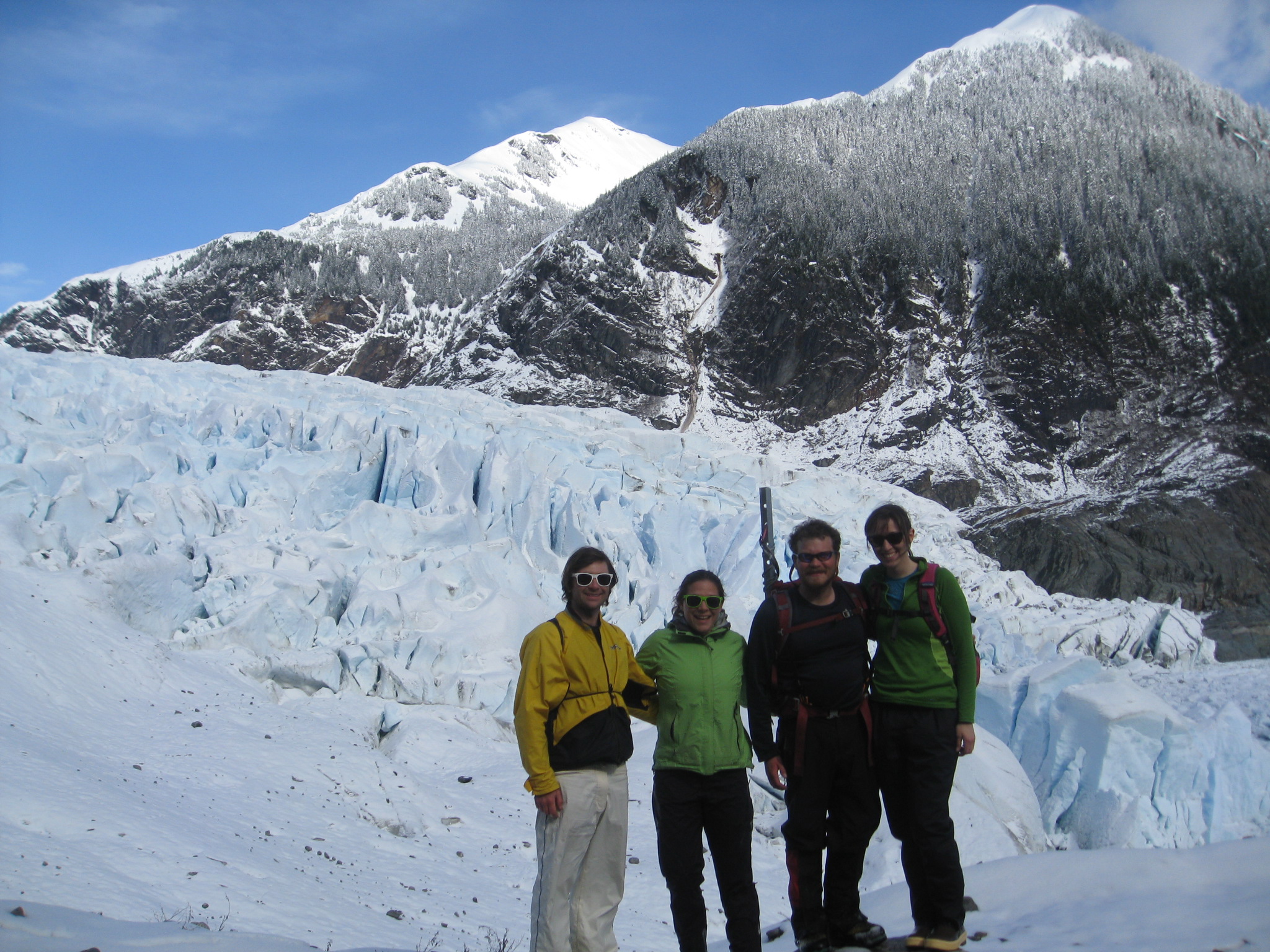
Dallas, me, Jason amd Christy in front of Mendenhall Glacier
We awoke on Sunday morning to snow, and an excellent view of mountains, which were surprisingly close and large, but invisible to us during the drive from the airport the previous night. Christy and Jason offered us a variety of options for activities for our day in Juneau, and we settled on going to check out an ice cave at the Mendenhall Glacier. Having both worked on the trails in Denali, our hosts were excellent guides for the hike up to and around the glacier. At some point, while scrambling up a rock wall, I had wished that I bought my med-evac insurance already. Fortunately, nobody fell into the glacier or off any cliffs. Also fortunate was the fact that we had stopped somewhere to buy waterproof rain boots on the way to the trail.
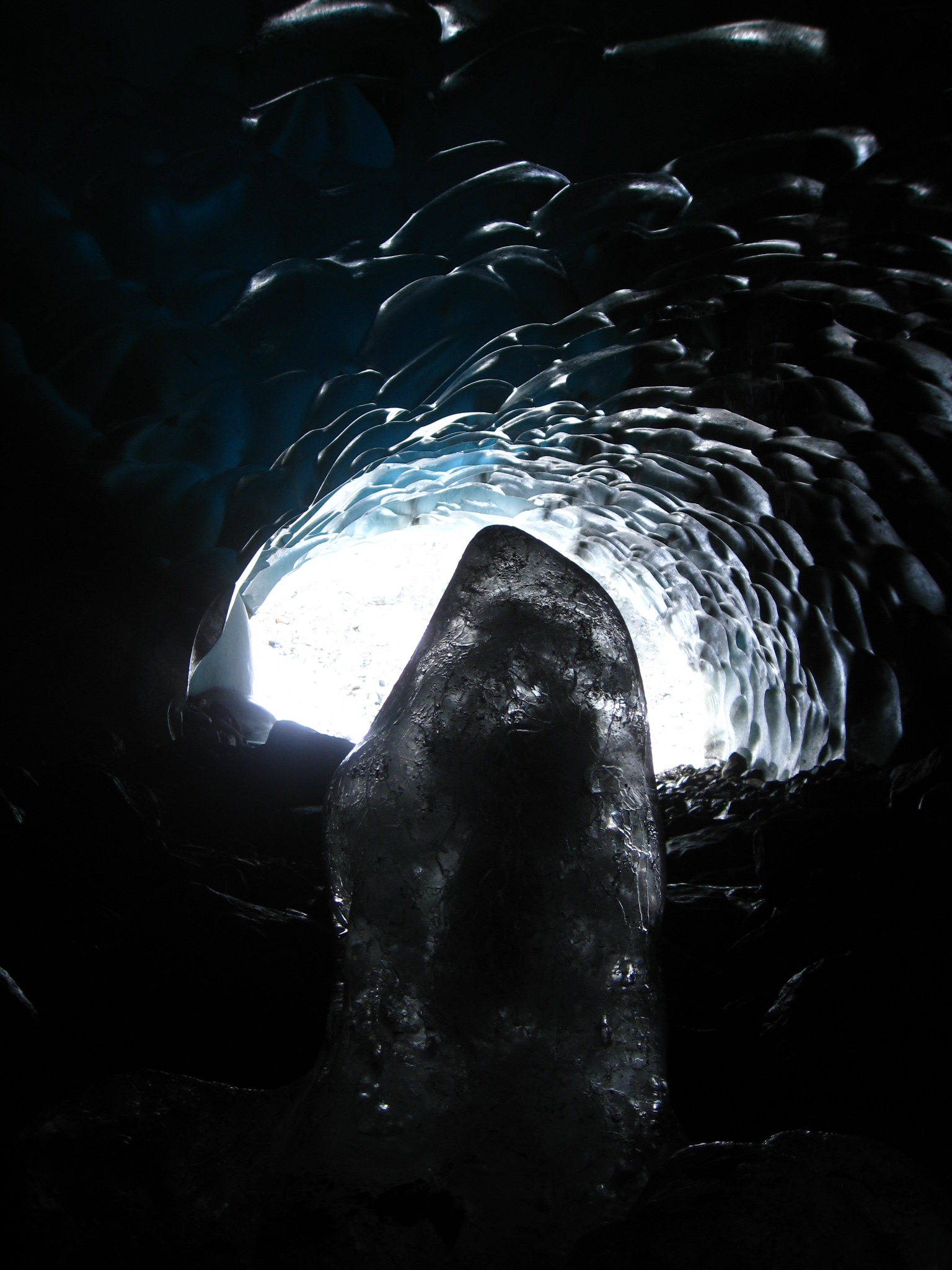
Looking out from inside the ice cave
The ice cave was cool (literally), but too dark inside to get any beautiful photos like the ones we had seen online before heading out there. We rested and snacked for a moment at the mouth of the cave (which is actually created by a stream that flows from the mountain into the glacier), and hiked back the long way along the shore of the fjord. The next morning, Christy and Jason drove us to the dock, where we boarded the Columbia, an enormous ferry that would take us to Haines and Skagway.
Having rushed to the ferry without having time to eat, we went straight to the snack bar on the upper level of Columbia, which didn’t have many appealing options for breakfast. Twelve dollars got us some barely edible broccoli salad, an egg salad sandwich and a waxy apple turnover. No sooner had we finished our food when the captain made an announcement that there was an all-you-can-eat breakfast buffet in the dining room. Oh well.

Close-up of a mountain goat before disappearing behind the mountain
The view on the ferry was amazing for the duration of the trip, and I had aspirations of whale watching and bear-spotting from the deck – but Dallas and I couldn’t stay awake for more than a few minutes at a time to appreciate it.


 Nomadic Cycling