Monthly Archives: March 2017
Sopó
15-16 January 2017
Angela and Juan Sebastian are siblings who were only kids when Lenin last paraglided in Sopó, but now they are running one of the biggest paragliding schools around Bogotá. We stayed with them for two nights, and Churro quickly made friends with their dog, Apollo, a beautiful Rhodesian Ridgeback about three times his size.

Churro waits patiently for the wind to pick up at the paragliding school.
We spent one full day in Sopó, hiking up to the paragliding school, waiting for wind that never came, and then hiking back down, accompanied by both dogs. On the way down, we opted to take a trail that was closed, but a policeman told us how to get there anyway. The trail was tough, and at one point became very steep and rocky. The dogs had trouble in a few spots, but we managed to coerce them down all of the tough areas until one part that involved a vertical drop of maybe six feet from a rock. I climbed down first, and Lenin was able to pass Churro to me, whom I safely transferred to the ground, but Apollo was too big to carry and wanted no part of it. He started running back up the mountain. Churro and I waited patiently for what seemed like over an hour while Lenin chased after Apollo. Apollo was very intent on not being forced down the trail, and he actually hid from Lenin in the bushes, holding his breath so that Lenin couldn’t find him. Lenin eventually succeeded in capturing Apollo, dragging him down towards me with his leash. Before he could make it to the difficult section, Apollo made another attempt to escape, this time breaking his leash, rendering it useless.
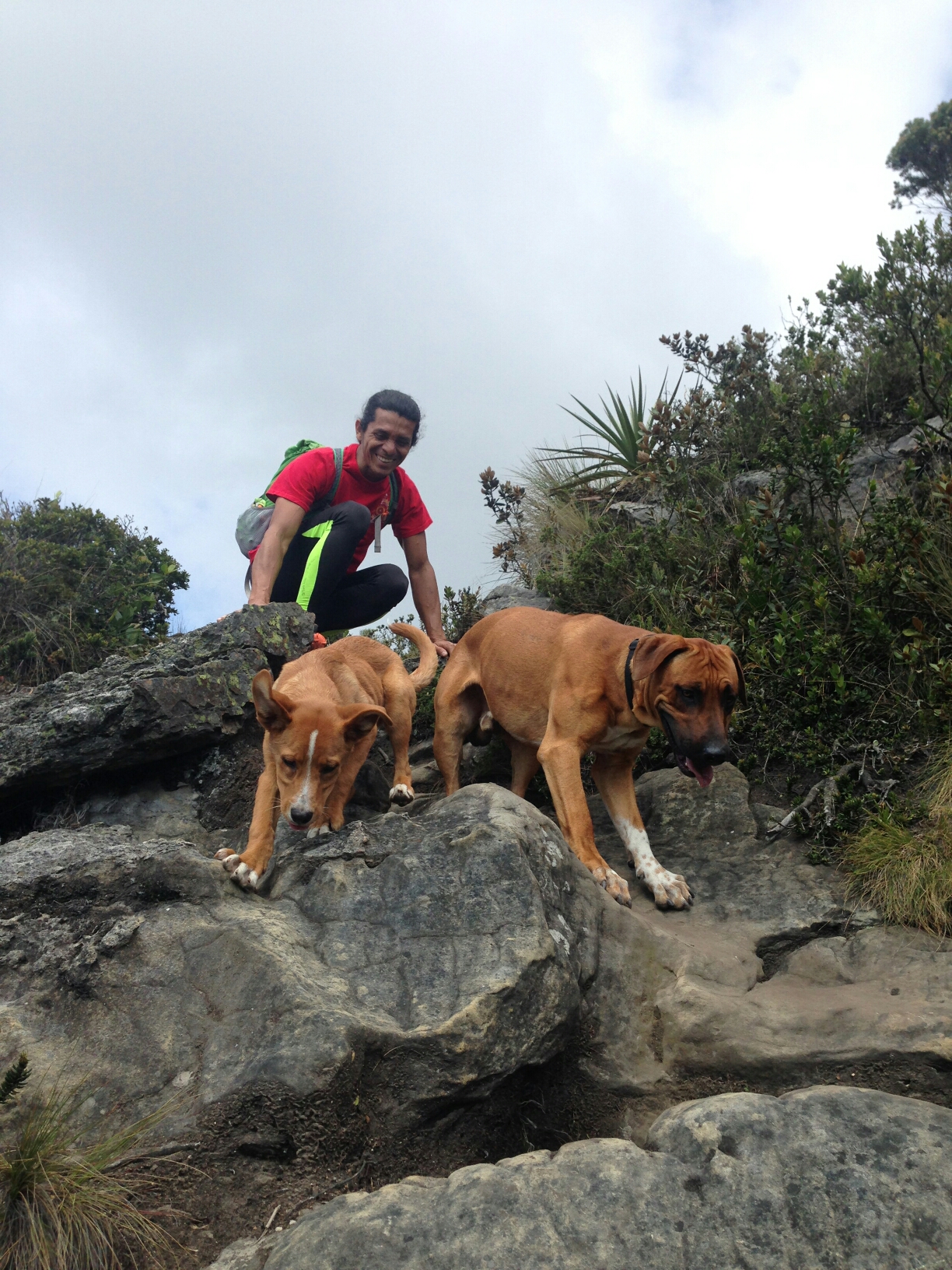
Churro and Apollo carefully climb down the mountain, followed by Lenin.
We had been hiking down for over an hour on this trail, having already traversed several tricky spots for the dogs, and to go back up to the road that we had walked up on would take a few more hours. We didn’t have enough daylight for that, and we were almost back down. We were starving, thirst, dizzy, and frustrated with the stubborn dog. It seemed ridiculous to climb back up the mountain only to go down again a different way, but both Lenin and I were considering that that might be our only option. Lenin went back up to look for Apollo, but he had no way of pulling him down so asked me to get Churro’s leash. Churro was napping with our backpack in a shady spot a bit further down the trail, so I went down to fetch his leash. On my way down, I heard some rustling in the bushes not far from the trail. There was an animal making its way through the vegetation towards me, but I couldn’t see what it was. Lenin was still high above us, trying to figure out where Apollo had gone, when suddenly out he came from the brush just below me and Churro on the trail! Lenin was moved by Apollo’s intelligence, remarking on how smart he was for the rest of our time in Sopó.
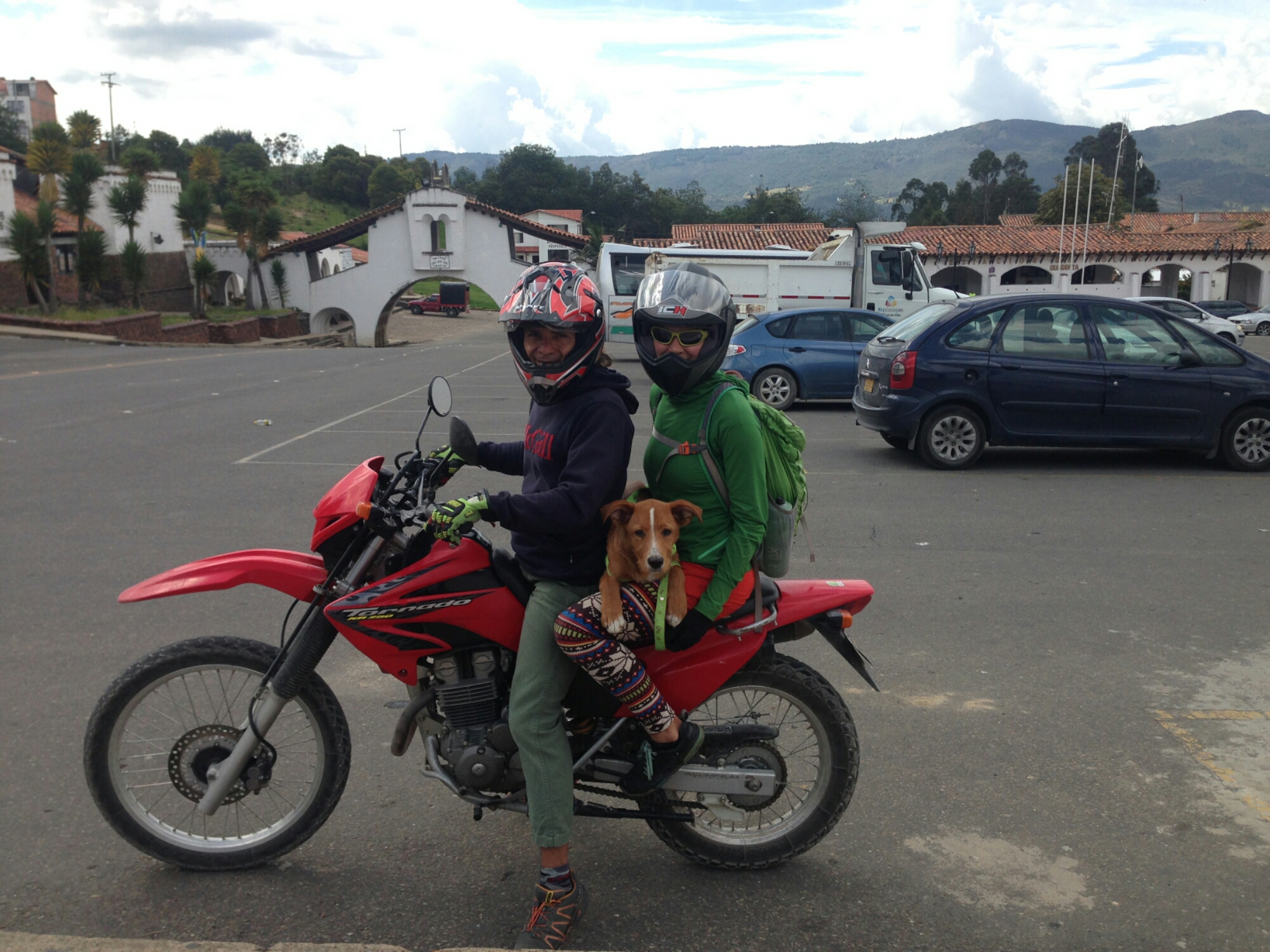
Churro’s first motorcycle ride went very smoothly, and he seemed to enjoy it!
The next day we borrowed Juan Sebastian’s motorcycle to get to Guatavita, a small town just across the lake on the other side of the mountain. This was Churro’s first experience riding a motorcycle, and he seemed to enjoy the wind on his face as he scrambled to get a better position between me and Lenin, resting his head on Lenin’s shoulder. I enjoyed watching him, with his jowls flapping in the breeze, though his nose was running, and mucous was flying back onto my arm.
From Guatavita we went up another mountain to get to the Laguna de Guatavita, where the legend of El Dorado originated. In this laguna, the indigenous leaders would go with all their offerings to the gods, filling a boat with gold, paddling to the middle of the deep lake, and dropping all the gold into the water. We should have done more research before going though, because the laguna was closed when we arrived. It would have been about an hour’s hike to the lake each way, and we still had to bike to Bogotá that afternoon, so perhaps it’s better that we didn’t go. Instead, we went back to Guatavita for lunch and back to the house in Sopó to pack our bicycles and leave.
Tunja to Sopó
14 January 2017
The ride out of Tunja was tough at first, climbing up and over the mountains. Juan Manuel had warned us that the first half of the ride would be rolling hills after a long 7km climb out of town. Lenin and I were tired, and Churro was heavy, but I felt there was too much traffic for him to be running at the beginning, and we had a long ride ahead of us still.
We let Churro run when the hills are more difficult to climb, but since he’s still a puppy and his bones are still growing we are trying not to let him run too much. Over the past few days, I think Churro has come to appreciate his ride and all the extra work that Lenin and I are doing to pull him along. He is usually restless in the morning, so when there’s not much traffic and we are going slowly up a hill, he runs. And he is usually very good about staying on the right side of the road, keeping our bikes between him and the travel lane. Only when we encounter other animals do we need to worry about him, because then his fear of the other dog or cow or goat on the grass makes him forget that there are cars on the pavement. We quickly learned to corral him into his trailer when we see an animal ahead, and he has quickly learned to feel comfortable going into the trailer when we ask him. It has become his safe zone, where he feels untouchable to the other animals.

This skull on the side of the road was just the omen I didn’t need during the miles that Lenin and I rode separately, in silent anger.
Lenin wanted Churro to run as we left Tunja, but I thought he should be in the trailer until we got further outside of town. We had been switching bikes every 10 kilometers to share the duty of pulling the trailer, but since Lenin was pulling the trailer at the time, he felt that I wasn’t considering him when I asked for Churro to take a ride. We argued about this until Lenin agreed to put Churro in his trailer, and then we rode separately without speaking to one another for the next 20 kilometers. The down side to traveling with someone for so long is the arguments that get blown out of proportion over stupid disagreements. The benefit to traveling by bicycle is that pedaling helps to burn off anger, and it’s hard to stay angry when you’re outside, on a bicycle, exploring a beautiful country.

Taking a break to play with Churro on the side of the road
We eventually stopped and calmed down at a park commemorating the battle where Simon Bolivar won independence for Colombia from Spain. The road between Tunja and Bogotá is nicely paved, with wide shoulders and very little debris or bumps, making for an enjoyable ride. We made several stops for snacks, and while sharing some treats on the side of the road, Lenin found someone’s wallet complete with their personal documents. He packed that into the trailer to try to contact the person when we had internet access.
We had to pedal over 100 kilometers just to get to the road to Sopó, and it was dark when we reached it. We made one last stop for food at that junction, and then rode the last 5 kilometers into Sopó, which is a playground for rich people who live and work in Bogotá. It is also the home of Alpina, one of the two major dairy manufacturers in Colombia. Lenin used to come here every weekend to go paragliding, and we had a place to stay with his friends who owned one of the paragliding companies.
Tunja and Villa de Leyva

Walking back to Tunja from Edna’s uncle’s finca in Combita
9-13 January 2017
We stayed several days in Tunja. The first day, after lunch, we drove up to Edna’a uncle’s finca in Combita, where the family there was making pizza. The climate here is on the cold side, and rainy, so after dinner we all went into the sauna and played Cranium while drinking beer.
On the second day, Lenin called Juan Manuel, and he took us on a bicycle tour of Tunja, which basically consisted of pointing out all of the nine churches in the city. He knew people on every street, and Lenin started calling him “Alcalde”, or mayor. Before going to his mom’s house for coffee and sandwiches, Juan Manuel took us to Nairo Quintana’s apartment building. He lives in Tunja, and is very receptive to visitors. However, when we asked the security guard if we could meet him, he told us that Nairo was in Bogotá for a social event.

Normally full of tourists, the main square in Villa de Leyva was empty when we visited.
We made plans to meet again the next morning to ride to Villa de Leyva, the second most touristy city in Colombia after Cartagena. The first ten kilometers was up, but the rest of the ride was downhill or flat, and the climate grew much warmer and drier in a short distance. We arrived before noon in the small town, where the main square and streets were made up of old cobblestones. This region is rich in paleontology and archaeological findings, including prehistoric fossils and indigenous ruins, and there are many museums, restaurants, shops and cafes in a relatively small area. Juan Manuel had to work that day, so he took a bus back to Tunja. Lenin and I ate lunch and walked around the town. Down one of the streets off the main square, I found the best gelato I’ve had since arriving in Colombia. Good ice cream is increibly hard to find, although there are many ice cream shops. Nearly all of them offer the same two brands of mediocre quality ice cream. Needless to say, the gelato in Villa de Leyva made me very happy.

Riding back to Tunja from Villa de Leyva, Churro slept most of the way.
We ended up finding a host on WarmShowers at the last minute, where we stayed two nights. There were two other travelers staying there, and we all shared a room. One girl was from France, but living in Bogotá, and the other was from Bogotá. The next day we all walked to the paleontology museum, but it was closed, so we ended up hiking up a nearby mountain instead. The family hosting us was incredibly generous with their space, as every room in the house contained multiple beds, including the kitchen, and it was unclear how many people actually lived there, or whether people had their own bed or just slept in whichever one was vacant at the time. We shared dinner and breakfast with everyone, with the girls from Bogotá cooking dinner and Lenin and I cooking breakfast. Churro made friends with their dog, Dakota, and he did not want to leave when it was time for us to go. We rode back to Tunja the second morning for one more night at Edna’s house before continuing south.
Moniquira to Tunja
8 January 2017
On the way out of Moniquira, we slowly made our way uphill for about an hour before we came across the finca that the tourist policeman had recommend to us the night before. We only had to go about 65 km to get to our friend’s house in Tunja, but there was a lot of climbing, and Churro in his trailer slowed us down considerably.
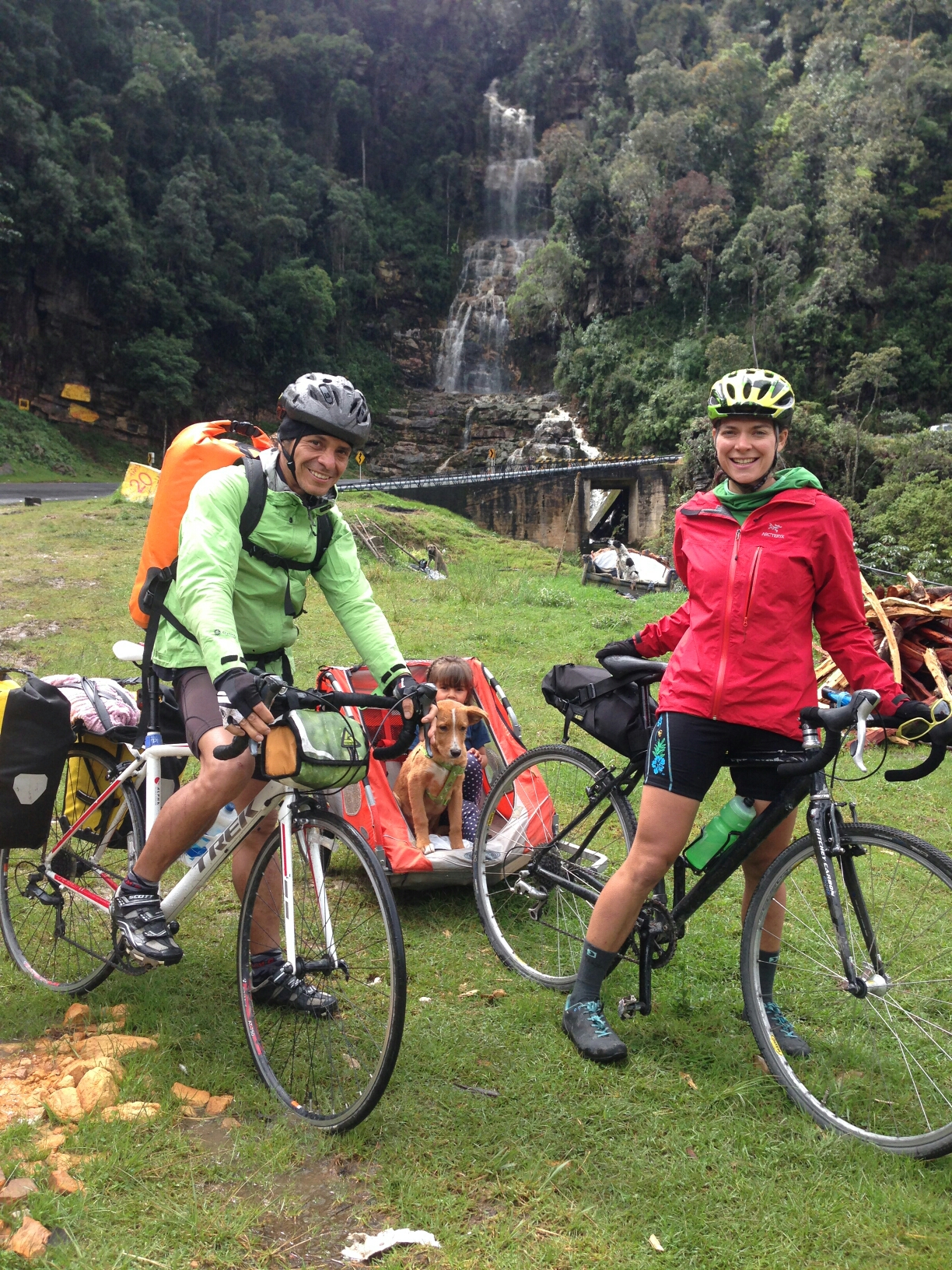
With the waterfall where we stopped to wait out the rain in the background, a little girl from the family that lived there joins Churro in the trailer for a photo
We finally started to descend a steep mountain when it began raining. The rain was cold and hard, and the on the way down we passed a magnificent waterfall. Shortly after this, and the only place for miles where one could pull over, was a house that happened to have an amazing view of the cascade. Lenin and I were not the only ones stopping here, as there was another couple on a motorcycle who had also come in to stay dry. The family inside seemed accustomed to frequent visitors, and they made coffee for all of us while Lenin and I changed into dry clothes. Lenin asked them why they don’t have a restaurant or some business there, with the perfect view of the waterfall, but the woman answered that there are too many thieves from Bogotá on the road. After waiting for about an hour, the rain let up enough for us to venture back outside. We continued on to a small town called Arcabuco, where we stopped for lunch. We got inside just a moment before the rain recommenced, this time for longer and harder than the first time.
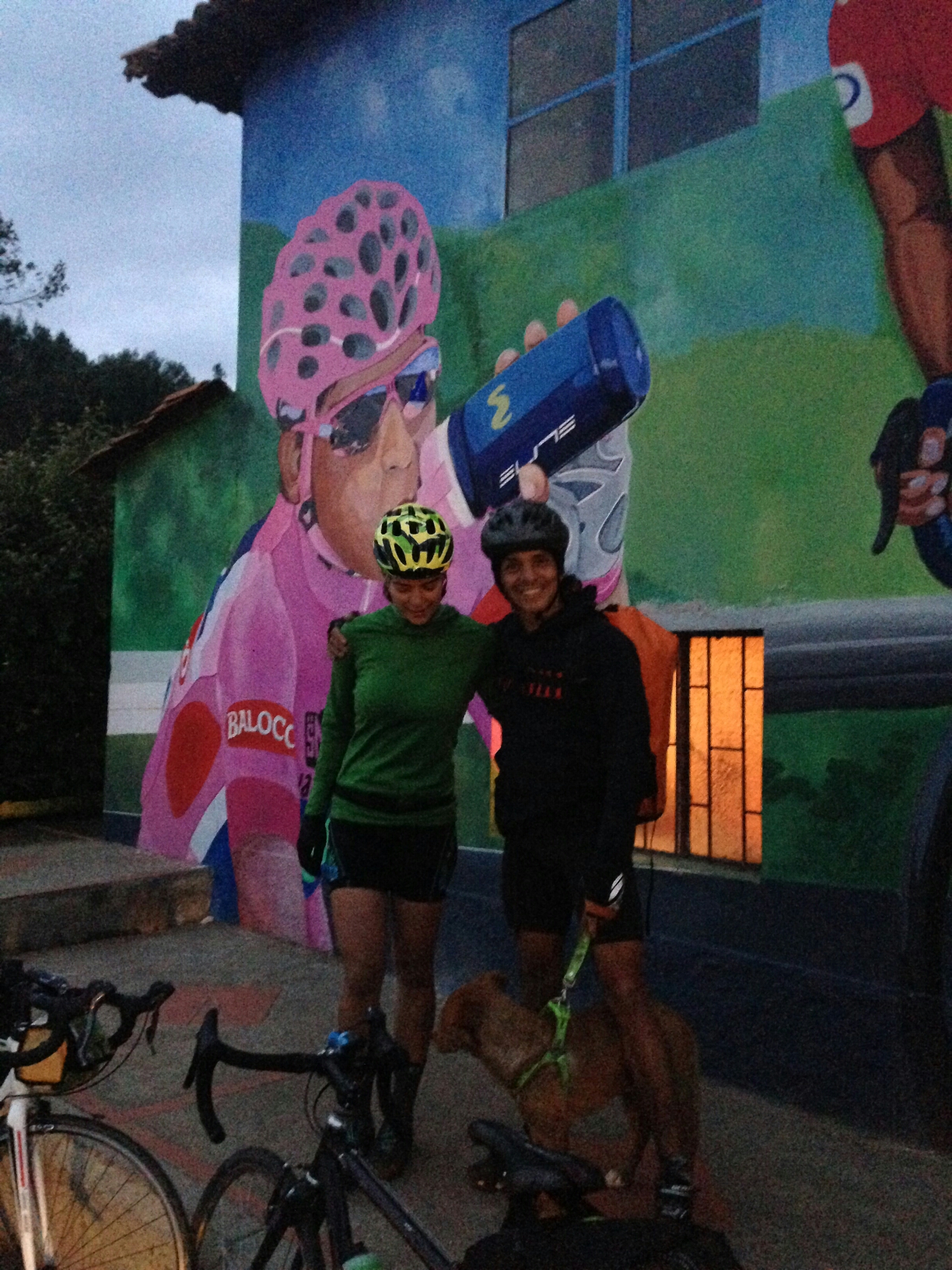
We stopped for a break just after sunset at the house where Nairo Quintana grew up
The rest of the ride to Tunja was uneventful, until we reached Combita, just 15 kilometers from our destination. The home where Nairo Quintana grew up is on our route, and it has become somewhat of a shrine to the superstar athlete. Nairo’s parents run a small tienda out of the house, selling mugs, shirts, souvenirs, coffee and other snacks. I had been anticipating arriving at this place all day, and it seemed to take forever to get there. The road was hilly, and weather was pretty horrible for cycling, and nobody seemed to know anything about distances or how long it would take to bike somewhere. Seriously, every time we asked someone how far the house was, they severely underestimated either the distance or the time it would take. Anyway, it was dark by the time we arrived at Nairo’s house in Combita, and all I wanted to do was rest inside and recharge. We had already wasted a lot of time waiting for rain to stop, and Lenin wanted to get on the road quickly to get to Tunja.
After a quick tinto (black coffee) and brief conversation with Nairo’s mom, we got back on our bikes. It was dark and cold, and from there it was all downhill, so we were going fast with not much pedaling, making me even colder. My front light died almost instantly, so I couldn’t see the cracks in the road. Within the first few kilometers after leaving Nairo’s house, I got a flat tire. I felt like giving up and hitchhiking right then, but we sat on the side of the road in the dark, fixing the flat with frozen fingers. From there, the descent was steeper and the pavement grittier and less consistent.
When we arrived in Tunja, Edna was still driving back home from out of town, so we sat at a cafe to pass the time. Two guys came up to us and bought us coffee, actually! They had seen us in Moniquira that morning and wanted to talk to us about our trip. One of them, Juan Manuel, was an enthusiastic cyclist who wanted to show us around the city, so he and Lenin exchanged phone numbers. When we finally met Edna and walked to her house, it was a relief to have a nice place to rest for a few days.
La Paz to Moniquira
7 January 2017
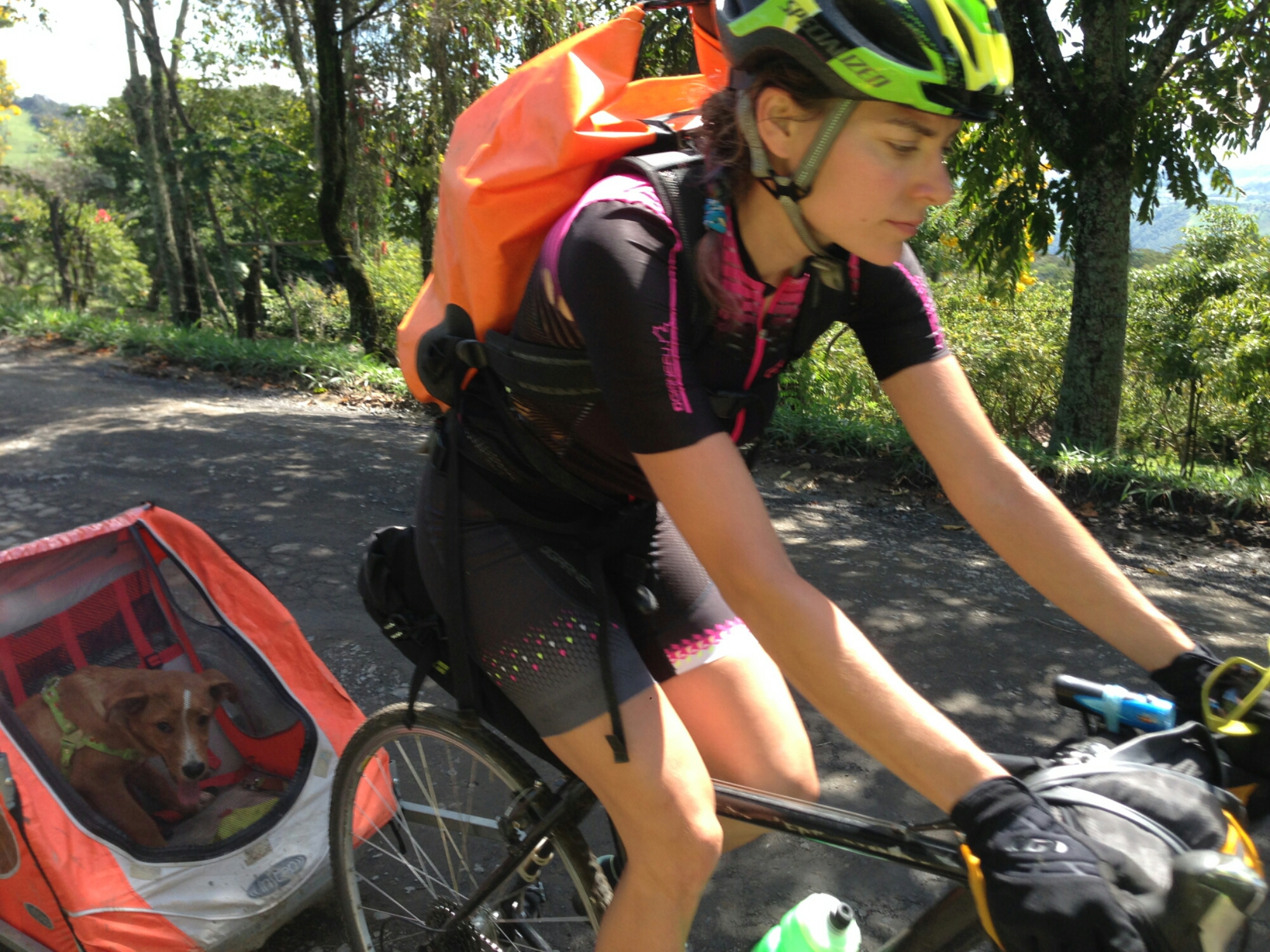
Churro is still adapting to the trailer, as we are adapting to pulling it over hilly, unpaved surfaces.
We left La Paz after breakfast, cycling a grueling distance on a hilly, unpaved carretera before arriving in Velez for lunch. From there, it was almost all downhill on pavement to Barbosa. In between Velez and Barbosa we were passing many signs for bocadillos, a paste made from the guava fruit. We were in the region where bocadillos come from, so we stopped at one of the places where they were making them. The man outside was in the middle of painting the building, but he went in and emerged with a fresh package of bocadillo, which he gave us for free.
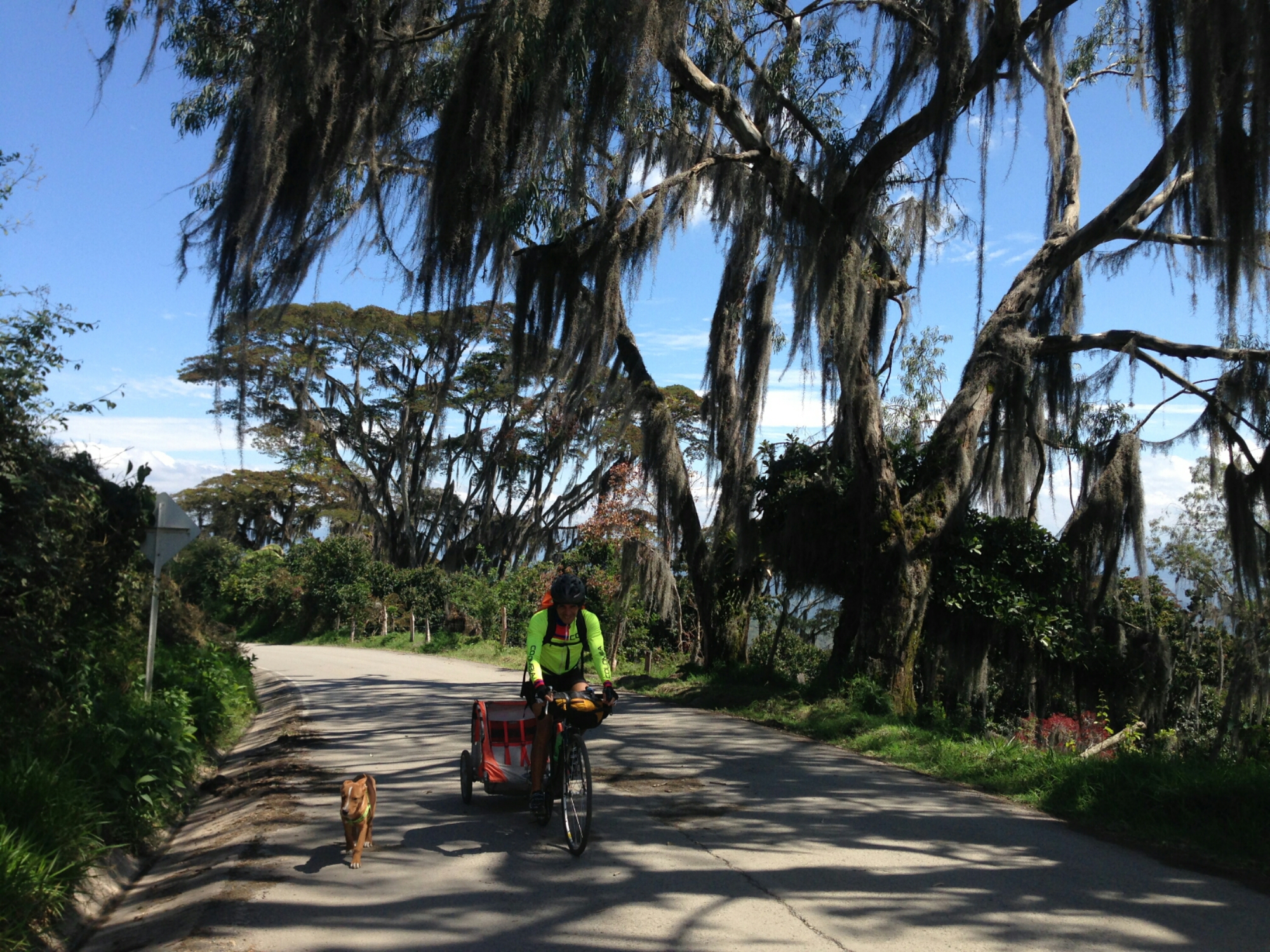
Churro’s preferred method of travel is his own four legs, but he only gets to do that when we’re going uphill on a quiet road.
Shortly after this, the shifter cable on the bike Lenin was riding snapped, and he was forced to ride in the hardest gear. We were climbing uphill at the time, so we stopped and sat on the side of the road, eating bocadillo while trying to see if we could fix the shifter. Sitting down again in surrender, it began to rain. Fortunately, we only had to walk a short distance to the top of the hill before we could coast down all the way to Barbosa and find a bike shop.
It was Sunday afternoon of a holiday weekend in Colombia, but we eventually found a bike shop that was open and able to replace the shifter cable. I was amazed at how inexpensive it was, and I bought new brake pads to hang onto for when the existing ones inevitably wear out. One guy at the shop told us that we had just missed Nairo Quintana, world champion Colombian cyclist, who was in town for a mountain bike race. A girl at the shop was very excited to meet someone to try to practice her English, and she asked me to talk in her Snapchat video before leaving.
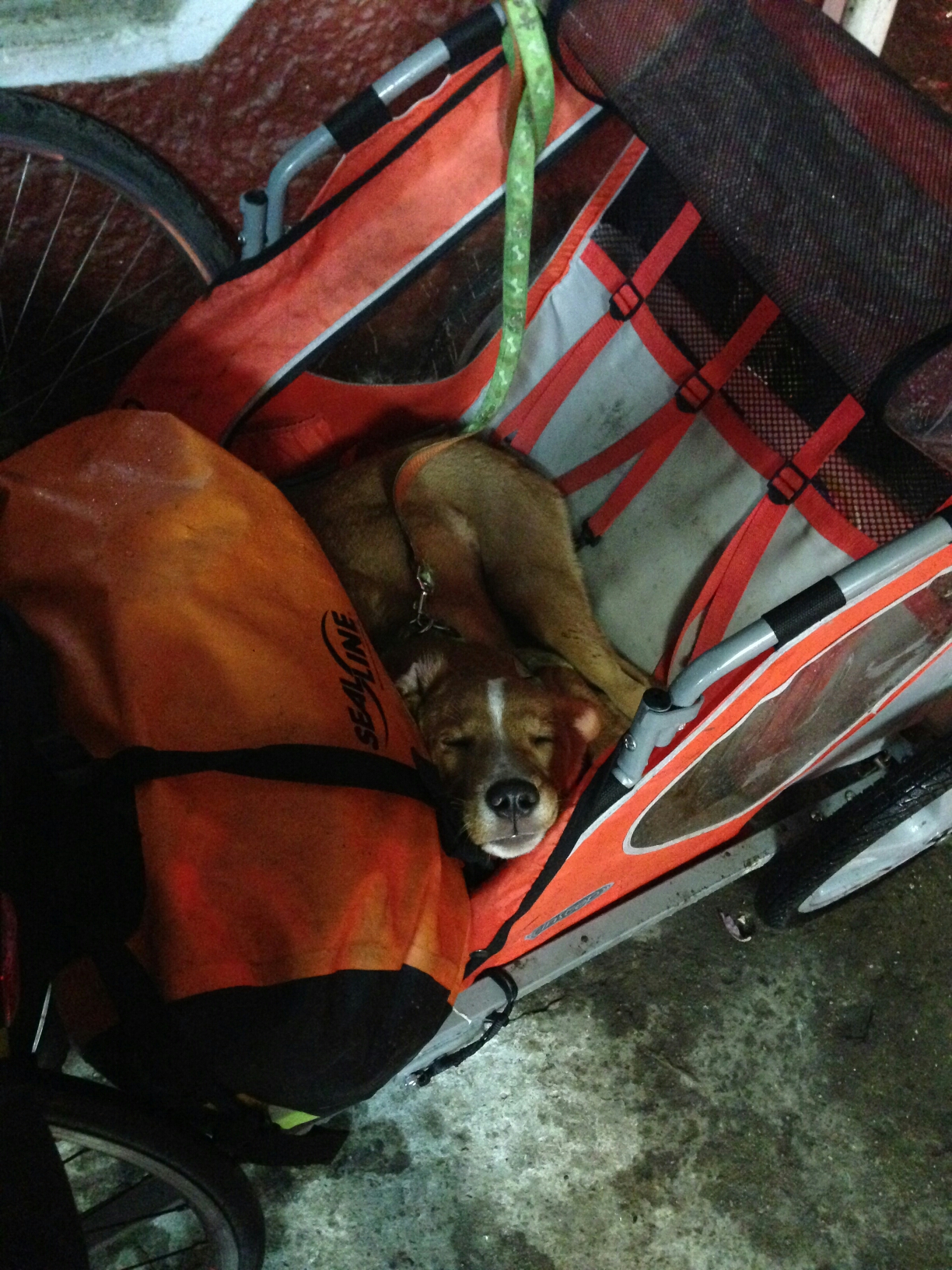
Churro’s trailer doubles as his bed, and he snoozes away while we try to wait out the rain.
When we finally got back on the road, we only had a short distance to travel to the next town, Moniquira, in the department of Boyocá. It got dark as we rolled into town, and it started to rain. I wanted to seek shelter from the increasingly heavy rain before my shoes got too wet, so we pulled aside and under the cover of a fruit market. The fruit man gave us some mandarins, and we sat and talked with him and his family for over an hour, trying to decide where to sleep, waiting out the rain, and hoping that maybe one of them would offer us a place to spend the night. The problem was that it was a holiday, and that town specifically had a special celebration that night where everyone sprays foam at each other. People were in town from all over, visiting family, taking up all the space that would normally be vacant. The rain wasn’t letting up, so we ventured out to ride across town to a church to ask if we could stay there.
We arrived, cold and wet, to the church, where we asked a boy if we could speak with the priest. The boy came back several minutes later, saying the priest was busy. His family was in town so we couldn’t stay there, but he gave us directions to another church in town, where we would meet the head of tourist police. The other church was only two blocks from the market where we had been passing time earlier. We waited for over an hour under an awning in the doorway of this church before Lenin finally found the tourist policeman. Every place in town was booked solid for the holiday, except for this one finca that the policeman estimated to be about ten minutes out of town by bicycle. Instead, Lenin talked him into letting us sleep inside a community building around the corner, which the policeman thought was too dirty. He obligingly unlocked the building for us, and we made ourselves comfortable on the floor of an empty room for the night.
Spontaneous initiation to an indefinite bike tour around Colombia
6 January 2017
Our decision to leave Medellín was very last minute, based on the fact that Lenin’s brother, Seled, was driving to get his family in La Paz, Santander, and he had just enough space in his car for me, Lenin, Churro, and our bikes. We folded down a back seat in his hatchback and stuffed in our bicycles, along with the trailer and all of our belongings, and joined Seled for the 8-9 hour drive. Within the first two hours we discovered that Churro gets car sick. While sitting on Lenin’s lap in the front passenger seat, he started to vomit. There wasn’t quite enough time to pull over, so he puked out the window, plastering the side of the car with half-digested dog food.

Churro despises his first ride in the trailer.
It was very late when we arrived in La Paz, so we stayed in a hotel that night. The next morning, we took Churro on a test ride in the trailer from the town to one of Seled’s in-law’s houses, about 10 kilometers away. He hated it, and we had to zip the screen on to keep him from jumping out.
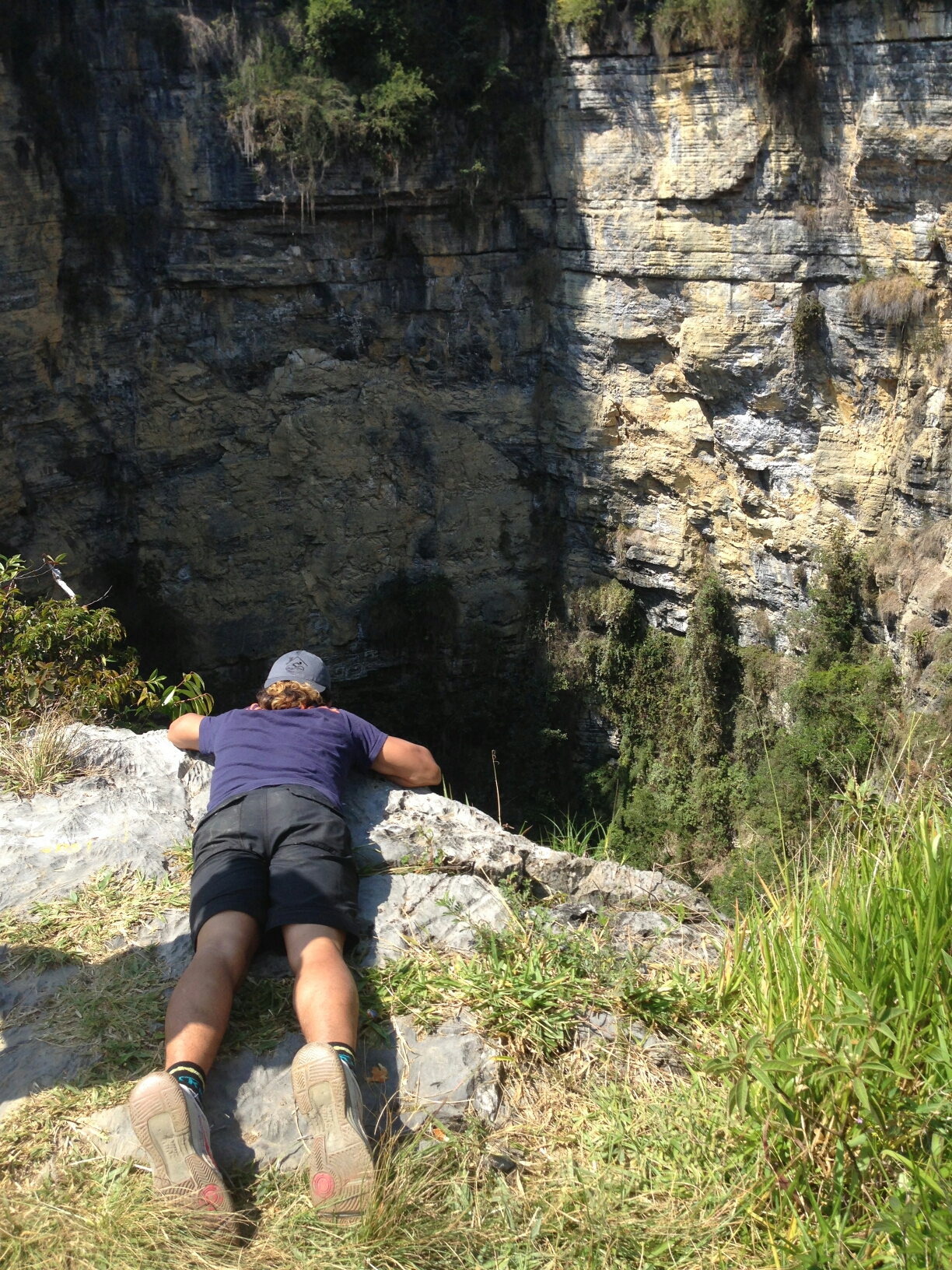
Lenin lies on the edge of this gaping hole, staring down into the abyss.
From the house, we got into the back of a pickup truck with Seled and his family and rode up to a giant hole in the ground, about 80 meters in diameter and 300 meters deep. Instead of riding back with the rest of the family, Lenin and I took Churro on a hike from the hole to where we were supposed to find a clear blue swimming hole. After a nice long hike in the wrong direction and back, we eventually made it to a river with a waterfall, but it got too difficult to walk along the river, and it was growing dark, so we turned back before we made it to the swimming hole. It was a long walk back into town, and we took turns carrying Churro the last few kilometers. Hopefully, he would still be worn out enough to relax in his trailer the next day.

Churro and me, towards the end of our hike out to the swimming hole that we never found
Medellín for the holidays
We came back to Medellín on Christmas Eve, a day that people celebrate by getting pigs drunk and then chasing them around the neighborhood before slaughtering them to roast outside. We arrived too late to participate in this ceremony, but the music, drinking and dancing went on all night. We walked around Lenin’s neighborhood for a while, visiting his friends and family.
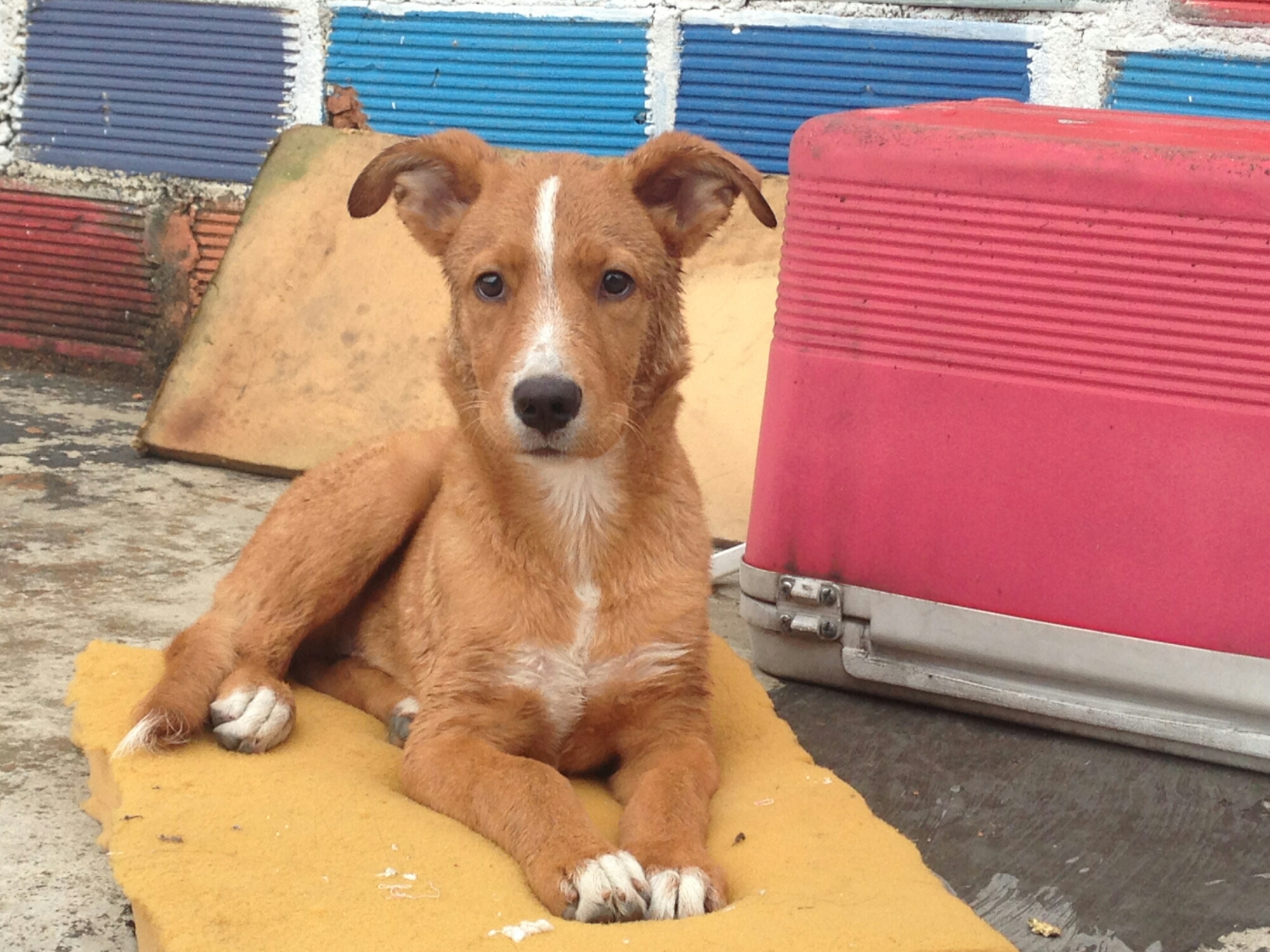
Meet Churro, a happy and curious mutt who loves to play, run, and eat meat
The next day, while walking to the market to get vegetables, I noticed a dog staring out the window of a veterinarian shop. On the way back from the market, I pointed him out to Lenin. We went inside to say hi, and four or five other dogs came to greet us. The one puppy who was most friendly with me was a mutt that they had rescued from the street, and the man told us he was free for adoption. We stayed and played with all the dogs for a long time, but in the end, I couldn’t leave without this puppy. The man in the shop gave us a leash, harness, two toys and a bag of dog food, and we left with our new dog.
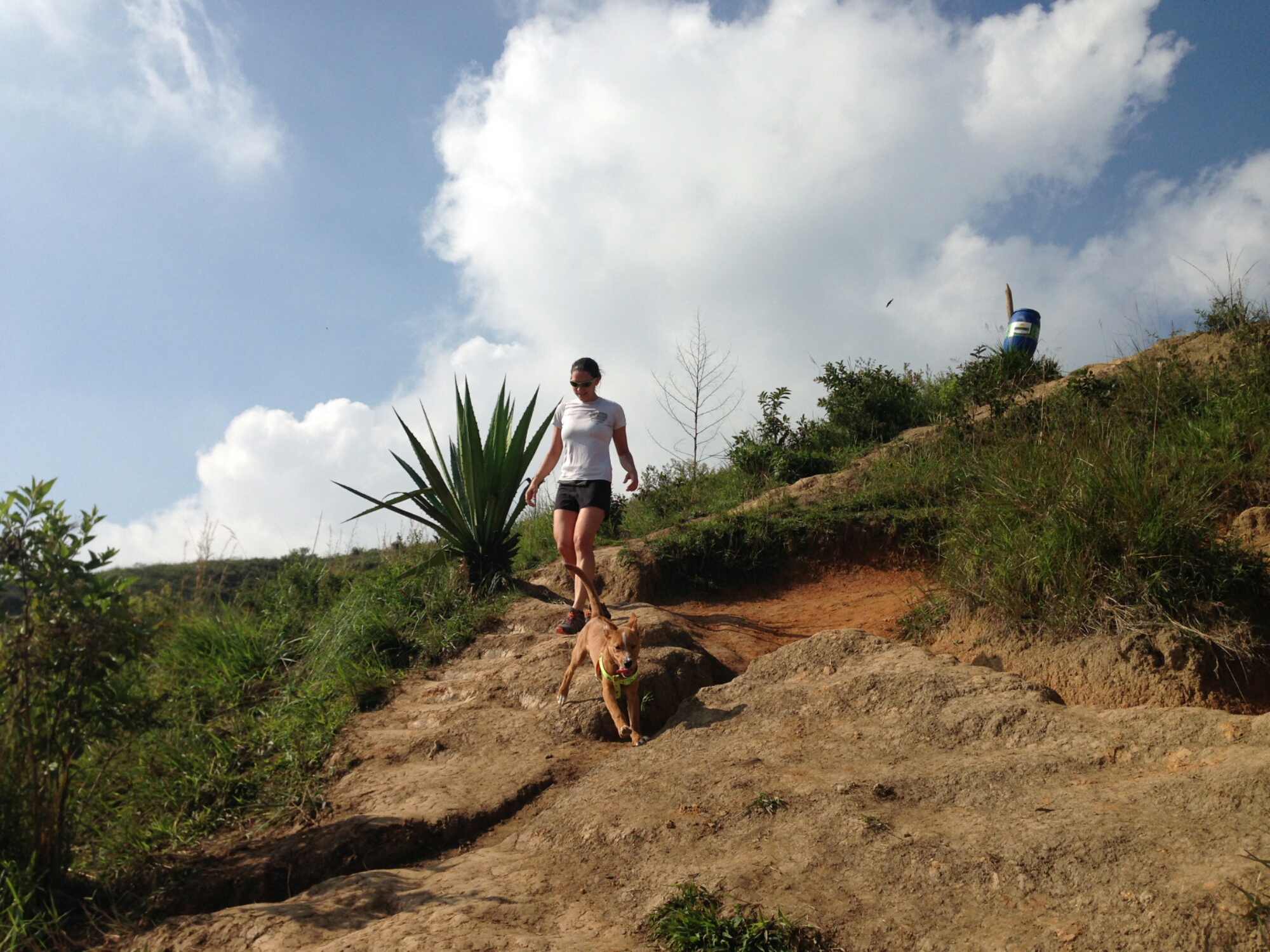
Churro is much faster than me at hiking, and this is only his first hike!
We named him Churro, and we immediately fell in love with him. He was quiet, smart, easy going and affectionate. He was only about 5 months old and had innocent eyes and big ears. Churro was very motivated by food and easy to train. Within the first week, we had taught him to sit, give his paw, roll over and jump.
Not only was Churro a fast learner, but he was athletic as well. He loved to run, and he was fast. We took him up to Tres Cruces and down again in record time. Our grandest adventure was a hike from La Sierra in Medellín up to Pan de Azucar and on to Parque Arví, where Churro discovered swimming for the first time. Every new experience for this puppy was a joy to watch.
After a week of taking Churro on adventures within and around Medellín, we were itching to get back on our bikes and explore more of Colombia with him. Lenin’s brother, Edwin, had a bike trailer that he had bought in the US to take his daughter biking, but he never used it. It took a few asks, but eventually he agreed to sell it to us. The day after New Year’s Day, we set off on an indefinite journey to ride our bikes with Churro around Colombia.
Getting off the farm – a chiva experience
24 December 2016
Lenin woke me up abruptly with an urgent request that we pack up everything and be ready to get on a bus in 30 minutes. The bus would drive by the road that was a 10 minute walk from the house, and we could get down to town that way instead of trying to ride our bikes down the horrible rocky road. Our bikes were another 10 minute walk or so down the mountain at someone else’s house, where we left them the night we arrived. All of our stuff was everywhere, including hidden away in the wardrobe by Luis’s wife, who had cleaned the house while we were away the day before. I didn’t want to argue, so I just started packing and got ready. I looked at my phone, and it was just past 7am.

This is before the chiva got a little crowded!
The two kids helped us carry our bags to the road, where several other people were standing at an abandoned house, waiting for the bus. Luis had left earlier to get our bikes and load them on the bus before it reached us. We waited for about an hour before anything showed up. It wasn’t just a bus, but a chiva – a traditional mode of transportation that comes by only on Saturday and Sunday mornings to take the farmers into town. We piled our stuff and ourselves onto the top, along with the other people and their various belongings.
On top of the chiva was a bench in the front, already full of people. The rest of the roof was flat with rails along the edge so the variety of things on top wouldn’t slide off. These things included huge burlap sacks of maybe beans or coffee, crates of empty beer bottles, empty gas/propane cylinders, bunches of plantains, a ladder, a weed whacker, our two bicycles, and a few other people who were brave enough to sit on top of the whole thing. I took a seat near the front on a sack of beans or something, and lenin sat on one of the gas cylinders.
 From where I sat on the left side, so high up, I felt like I could easily fall out and over the cliff into the steep valley below. The road was too narrow to see on the sides of the chiva below us, and I felt it sway from side to side as it struggled over the rocky terrain. We continued up and over the mountain to pick up more people before heading down into town. At one point the chiva couldn’t make it around a tight turn on the steep climb, and it had to back up several times to get it right. This was the most terrifying part, and I had to have a lot of faith in the driver and whoever was guiding him, as all I could see was my side of the chiva getting closer and closer to the edge of the cliff each time it backed up to try again. I breathed a sigh of relief when we finally made it around the curve, but we still had a long way to go and had to stay alert to duck under the tree branches and cables. One benefit of being so high up and close to the trees, aside from the terrific view, was that we were able to pluck fruit from the branches as we passed underneath. Along the road were mandarin, orange, lemon, guava, avocado and guama trees. I had never tried guama before – a large pod containing black seeds surrounded by an edible, sweet white flesh. I also never realized that all guavas are full of parasitic worms, and people eat them like that without even thinking about it! Maybe that’s why they only sell the juice in the US.
The only thing this chiva was missing was the music. Lenin told me that chiva rides can be very long, and normally the passengers, mostly farmers, will take their instruments and play music, drink beer, and party during the ride. When Lenin was a boy in Uramita, people would sometimes take a chiva to Medellin, a 10-hour or more drive on unpaved roads. Sometimes there would be a landslide on the road, and they would be delayed for a few days, so everyone brought tons of food to cook along the way. Nowadays in Colombia’s more touristy cities, chivas are purely used for entertainment. They can be rented out for parties, and people just drink and dance inside while the bus slowly rolls through the city.
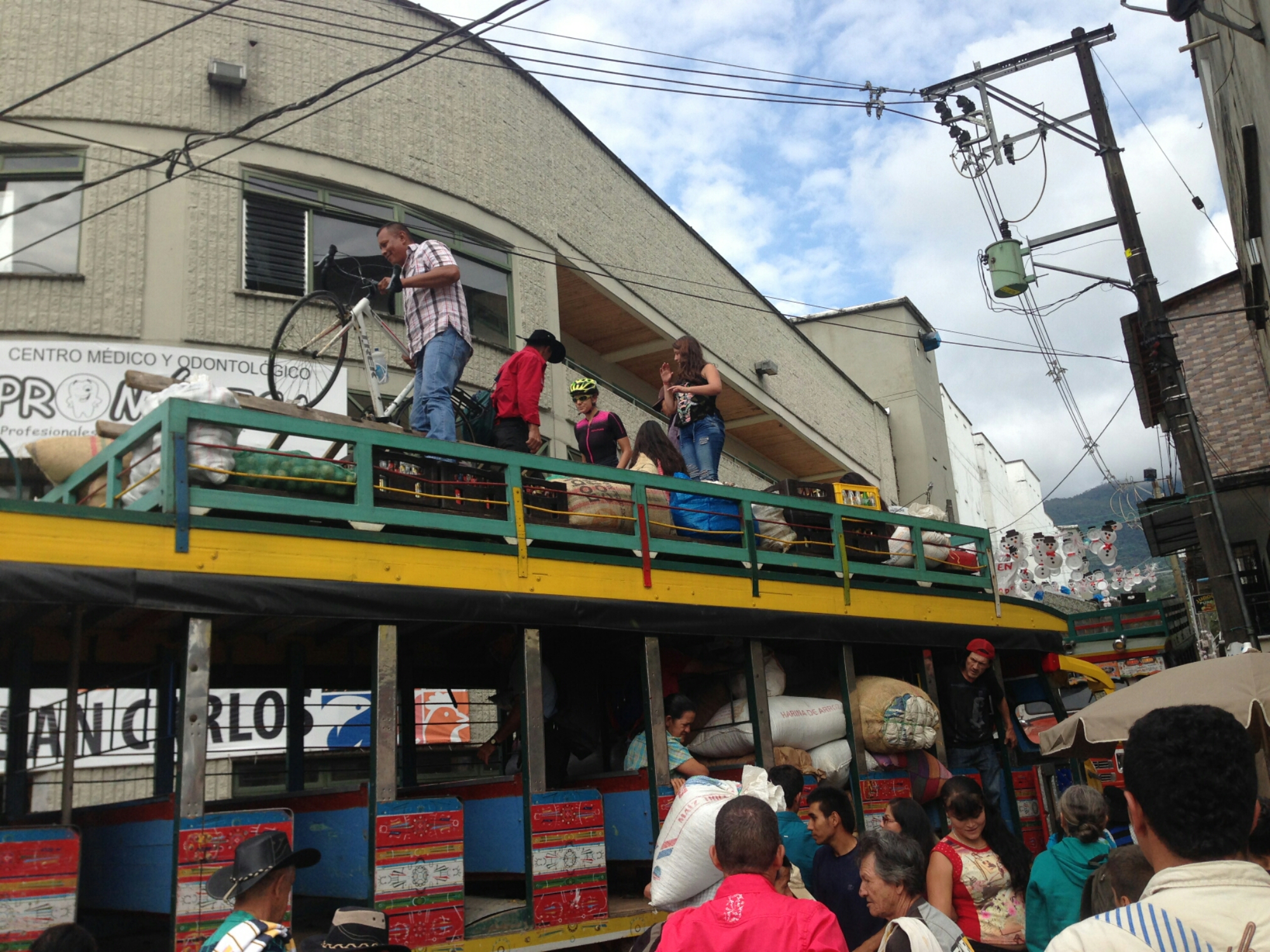
Unloading the Chiva in San Carlos
When we finally rolled into town, we still had to fix a flat tire before heading out of San Carlos. We only made it a few miles outside of San Carlos before Lenin got another flat tire! At least this road was mostly paved. The flat happened when the paved section turned into dirt for a few feet. My exhaustion was catching up with me, and after 30 miles or so of rolling hills, I wasn’t really feeling like pushing myself that hard. We stopped for a few coconut popsicles at a roadside shop, and when Lenin got another flat tire about a mile down from there, we decided to wait for a bus. While waiting, we saw some wild titi monkeys cross the road just a few meters ahead of us before climbing high into the trees. Instead of hopping on a bus, we were able to hitch a ride from a guy driving a small, empty truck. We loaded into the back and enjoyed the free ride into San Rafael. From there, we had about an hour to wait for a bus back to Medellin so we could come back for Christmas Eve.
Puerto Rico to San Carlos
23 December 2016
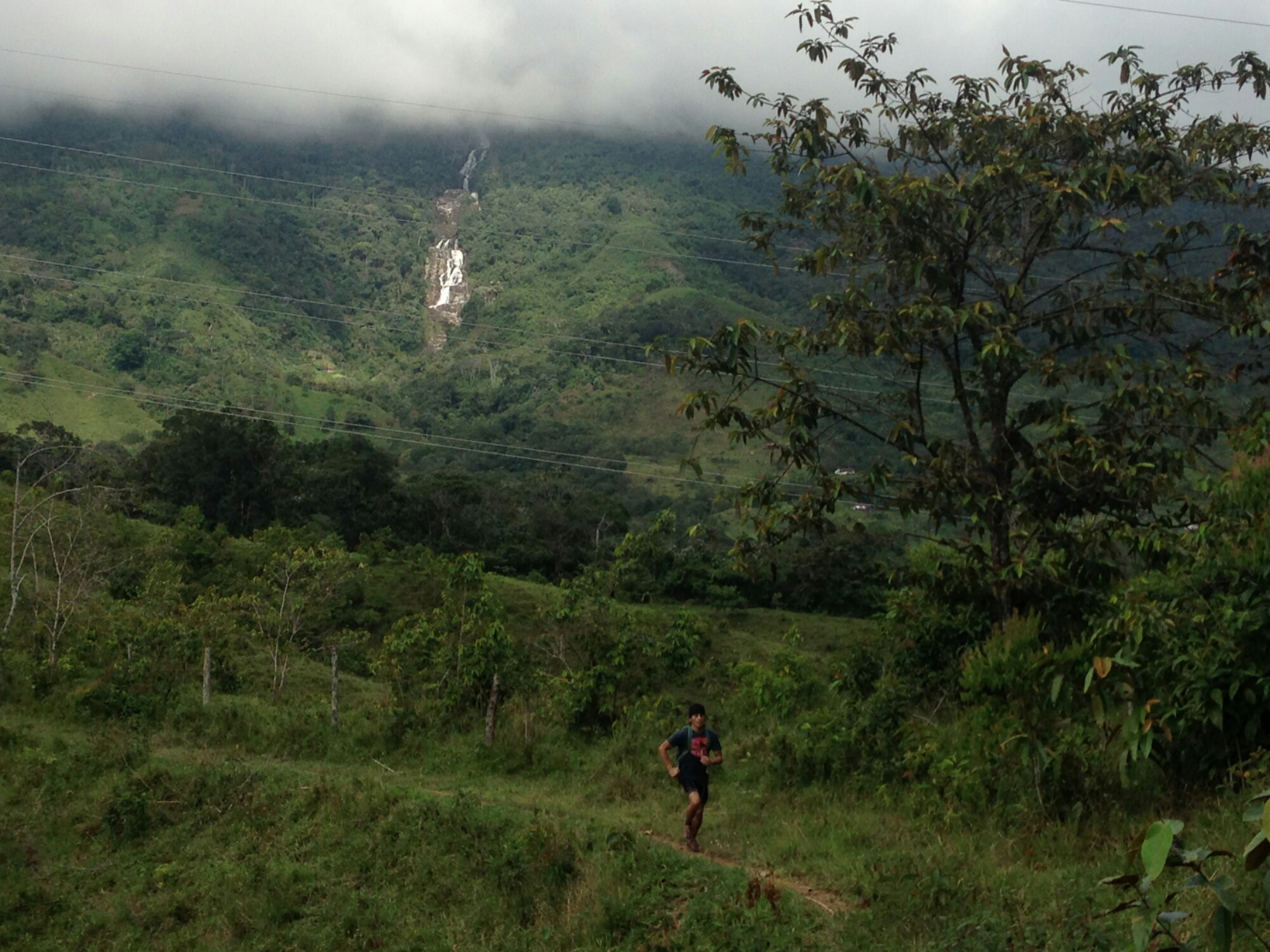
Lenin runs along the trail, with a beautiful backdrop of a waterfall on the distant mountain
Originally, we were going to bike back to Guatape after one night in Puerto Rico, but it was so beautiful and so difficult to get to that we decided to stay another day. We rose early to run to San Carlos, about five miles away. Before leaving, Lenin got instructions from Luis, the father of the family caring for Paola’s house, for how to get there via trails instead of taking the steep and rocky road that we had driven up the previous night. We started off on muddy trails through cow pastures, following the heavy footsteps of the cows. Sadly, much of the land has been stripped of its natural vegetation and replaced with grass, lowering the tolerance of the land for rainwater. The saturated land doesn’t have enough trees or other plants to soak up the water, so it ends of being muddy and slippery, also creating landslide hazards. Fortunately, we soon entered a more untouched section of jungle where the trails were dryer, and we gained more traction.

We came across someone’s house here in the middle of the mountains, surrounded by pineapples growing on the hillside.
According to Luis’s directions, we were to cross under the powerlines and bear right on the trails when we came to a big tree. Then we would come to a house with an old lady and about 20 dogs. I’m not sure what we were supposed to do when we got there, but we did eventually come to this house with numerous dogs. At that point, we encountered two people on horseback who were also going to San Carlos. They led us back on the right track, and we chased the horses as fast as we could until they got too far ahead. This trail led us to a river where we crossed an old, narrow bridge that was suspended over the river. From there, we had to ask a farmer for directions again, since we somehow ended up in his backyard. The trail finally emerged into the outskirts of San Carlos, and we walked into the center of town for lunch.

Here is the narrow bridge we had to cross shortly before emerging into the town of San Carlos
After lunch, we decided to climb up to la Piedra del Tabor – another giant stone like the one in Guatape, but with no stairs and even higher of a climb. As we walked back out of town, we passed a dog who was lying in the sun. He got up, and we invited him to follow us. There are hundreds of stray dogs in every town, and it’s so hard to ignore them. This one was very friendly, cleaner-looking than most, and looked to be about 2 years old. He was maybe a cross between a yellow lab and pit bull. Lenin asked several people in town how to get to the stone, and once we were on the road out of town, he asked one more farmer about which trail to take. At this last junction, before traversing the farm and entering the narrow, steep trail, Lenin comments, “funny, they all say the same thing, to be careful of the tigers”. You can imagine how I felt for the rest of the hike up to the stone.

We rose above the clouds while hiking up to the large stone. My face is uneasy because of the snake I just saw…
At one point, we stopped to bathe in a waterfall and refill our water bottles with fresh spring water. When we finally reached the stone, it was already growing dark on the shaded trail. The toughest part of the climb began near the base of the stone, and we continued up the even steeper, more slippery trail. We emerged from the woods and had yet more rocks to climb. The dog almost couldn’t make it up one of these rocky sections, and he stood whimpering until we encouraged him enough to jump for it. Just past this point, Lenin saw a poisonous snake. We couldn’t go much higher than this because the rock was too slippery and there was no easy way to climb, as it was nearly vertical. It was still sunny up on the rock, but we needed to move quickly to get out of the woods before it became impossible to see. For the entire hike back down, I was scared of both tigers and snakes while I tried not to slip on the muddy trail. Going down is always harder for me than climbing up, but I think I went faster than usual this time.

We really loved this dog, and we considered adopting him.
Once we were in the clear again, we shared our leftover lunch with the dog. Back in town, he got distracted and wandered away to say hi to some other people, and we never saw him again. That night we agreed that if we saw the dog the next morning we would take him with us to Medellin. To get back to the house in Puerto Rico, a moto-taxi cost a minimum of $30,000 pesos ($10). We debated staying in a hotel in town that night instead, since it was cheaper than getting a ride back, but then Lenin found a guy on a motorcycle who was willing to take us there for only $20,000 pesos. We needed two motorcycles though, so he had to find someone else willing to go for $10,000. He came back a few minutes later with another guy on a motorcycle, and we each got on the back of one. The ride was insanely bumpy, but I felt much better on the motorcycle than I had the night before in the pick-up truck.
The things people do in this country on a daily basis is astounding, and commutes like these are probably most bewildering to me. For example, Lenin and I met some farmers selling honey in San Rafael who walk 2 hours each way every day from their bee farms to sell their honey. They don’t just walk on flat roads – they walk over mountains on gnarly trails that are sometimes washed out by landslides or covered in deep mud. The people we met on horses while trail running earlier were probably just going on a routine trip into the town for groceries or something. The next day we would experience yet another mode of transportation to get us out of Puerto Rico for the final time.
Guatape to Puerto Rico
22 December 2016
When we went to Guatape, we packed everything, including our bicycles, just in case we didn’t come back to Medellin. When your only plans are to “go with the flow” you never know where you may end up. We ended up staying on Edwin’s house boat in Guatape for three days because I was too sick to go anywhere.
When we finally left Guatape, it was to bike to Lenin’s friend Paola’s finca in the mountains just outside of the town of San Carlos. We would bike there via San Rafael and then bike back the next day to catch a ride with Edwin back to Medellin for Christmas. Paola wasn’t able to go to the finca because she was pregnant. I didn’t understand why this was a problem until we got closer. We were traveling very light, and I felt less prepared than I ever have before started a bike tour, but I figured we would be fine.
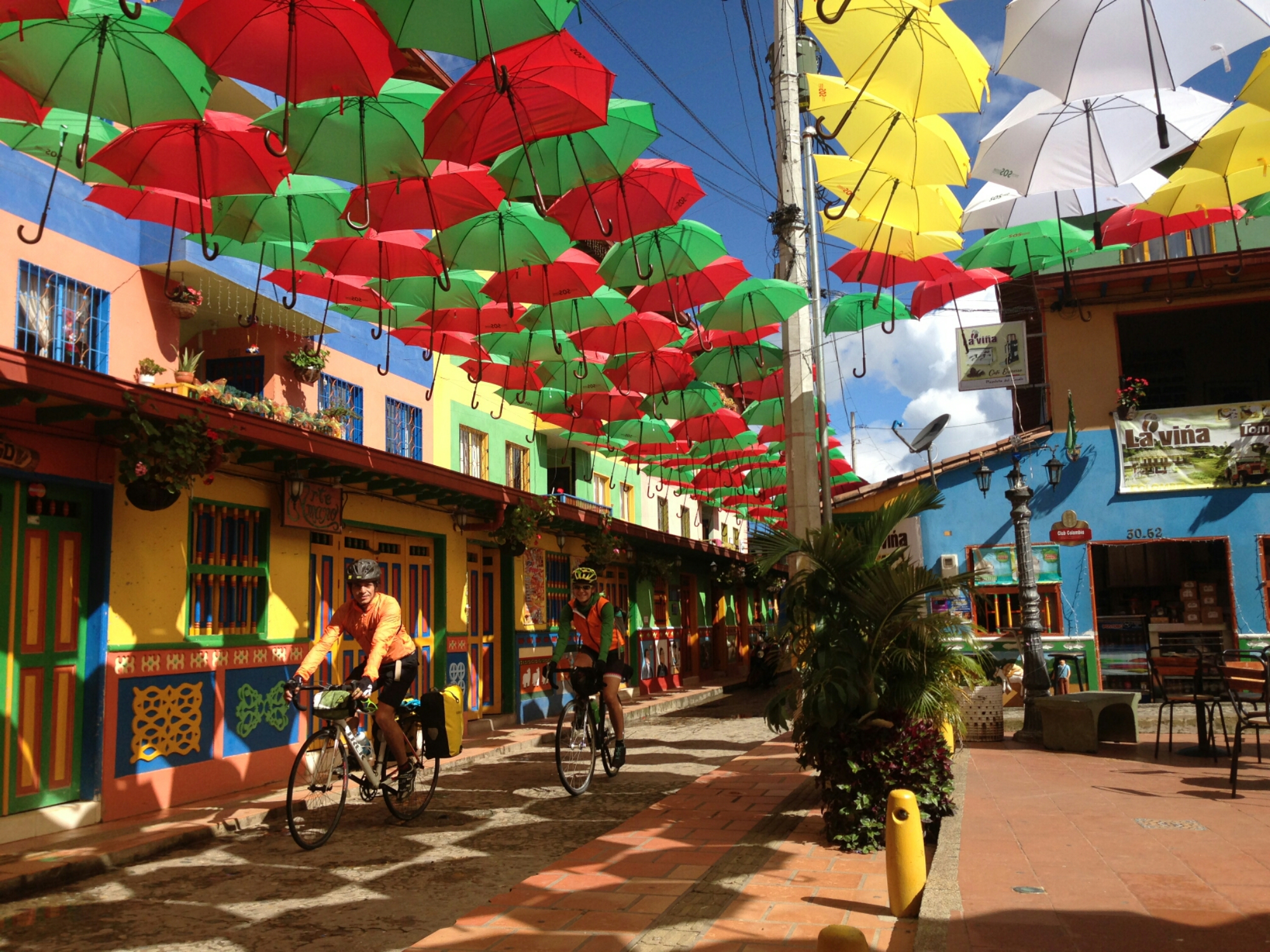
Heading out from the colorful pueblo of Guatape
The first 20 miles to San Rafael went by in a flash. The road was smooth, predominantly downhill, and the weather was perfect. We coasted all the way down to San Rafael from Guatape in about an hour. The total distance for the day, according to Google maps, was only just over 30 miles. We were thinking of having lunch in San Rafael, but it was still early, so we just stopped for a snack at a bakery and decided to keep going. Before leaving, someone asked us where we were going. When Lenin answered, “San Carlos”, the man seemed surprised and told us that it was 60 kilometers. That didn’t seem right, so Lenin asked a policeman to confirm the distance. He told us it was 42 km. Double-checking our map, we still saw a way that was only 13 miles. When asking around town about this route, everyone answered that it was impossible to go by bicycle, and that it would take much longer, even though it was half the distance. We decided we were up for the adventure, so continued to follow our map in spite of all the warnings.

The road from San Rafael, long before it got too gnarly
Almost immediately upon leaving town, the pavement disappeared and the road started to ascend up a mountain. We then encountered two police officers on motorcycles who told us yet again that the road would be impassable on our bikes. We kept going. The next stretch of road was so muddy that our pedals would hit the mud when riding in the ruts left by previous, much heavier vehicles, but we still managed to muscle through the deep mud. Eventually the road grew steeper, and the mud was replaced by loose gravel and jagged stones. When it started to rain, Lenin and I took a break. Lenin had just been explaining to me that we should talk to people we pass because they might invite us in for a coffee and then we can wait out the rain. I didn’t have any expectations of seeing people who would welcome us inside on this lonely road, but sure enough, when it started raining there was a house on the side of the road with a woman who invited us to come under the roof to stay dry. While we were there, she made us coffee from beans that she grew herself.
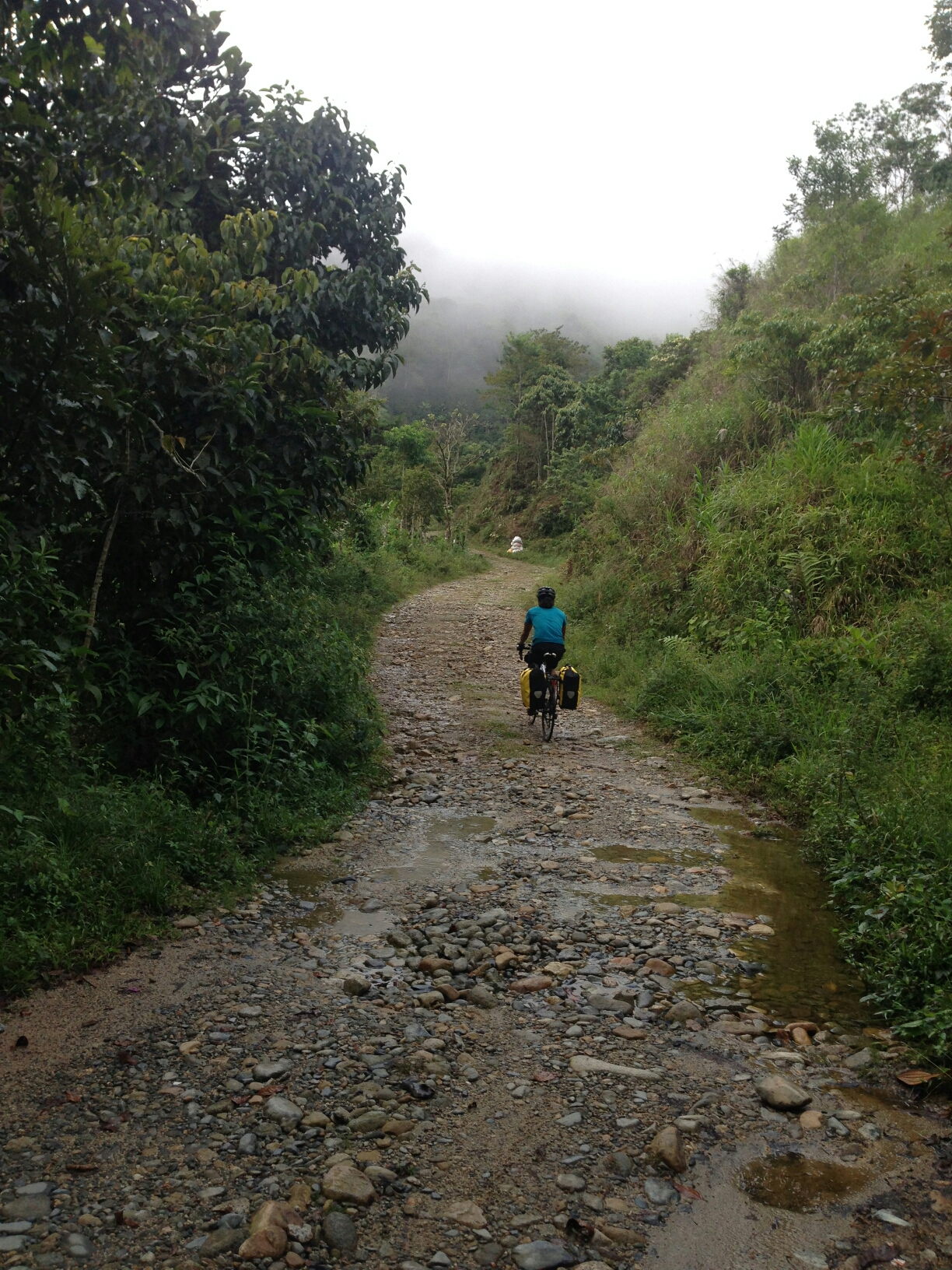
This road was rocky, but it gets worse…
At this point, Lenin decided to put more air in his tires, since he had let some out in between Guatape and San Rafael in fear of the tire exploding with the rising temperatures earlier in the day. Now we were on a rocky road and needed as much air as our tires would permit. Before leaving the woman’s house, he noticed that his tire had gone completely flat. We quickly replaced the tube, as the old one now had a hole near the valve stem, and got back on the road. However, less than a mile up the road, Lenin got another flat. Of course we hadn’t brought a patch kit or tire levers, so Lenin used his toothbrush to pry the tire off the rim. Since we had already used the spare tube, I decided to try tying a knot in the tube around the hole, since I had seen my friend Amanda do this once while mountain biking with some success. It actually worked quite well, until Lenin got yet another flat tire while testing it out. Then it started raining again. Since we couldn’t tie another knot in the tube, we resorted to using the extra tube for my bike, which was about a centimeter wider. This lasted only another mile or so before he flatted again. This time the air was leaking out slowly enough that Lenin could pump it up and ride a few hundred yards on it before having to stop and pump it up again. He quickly tired of this though, as the tire began losing air more rapidly with each repitition.
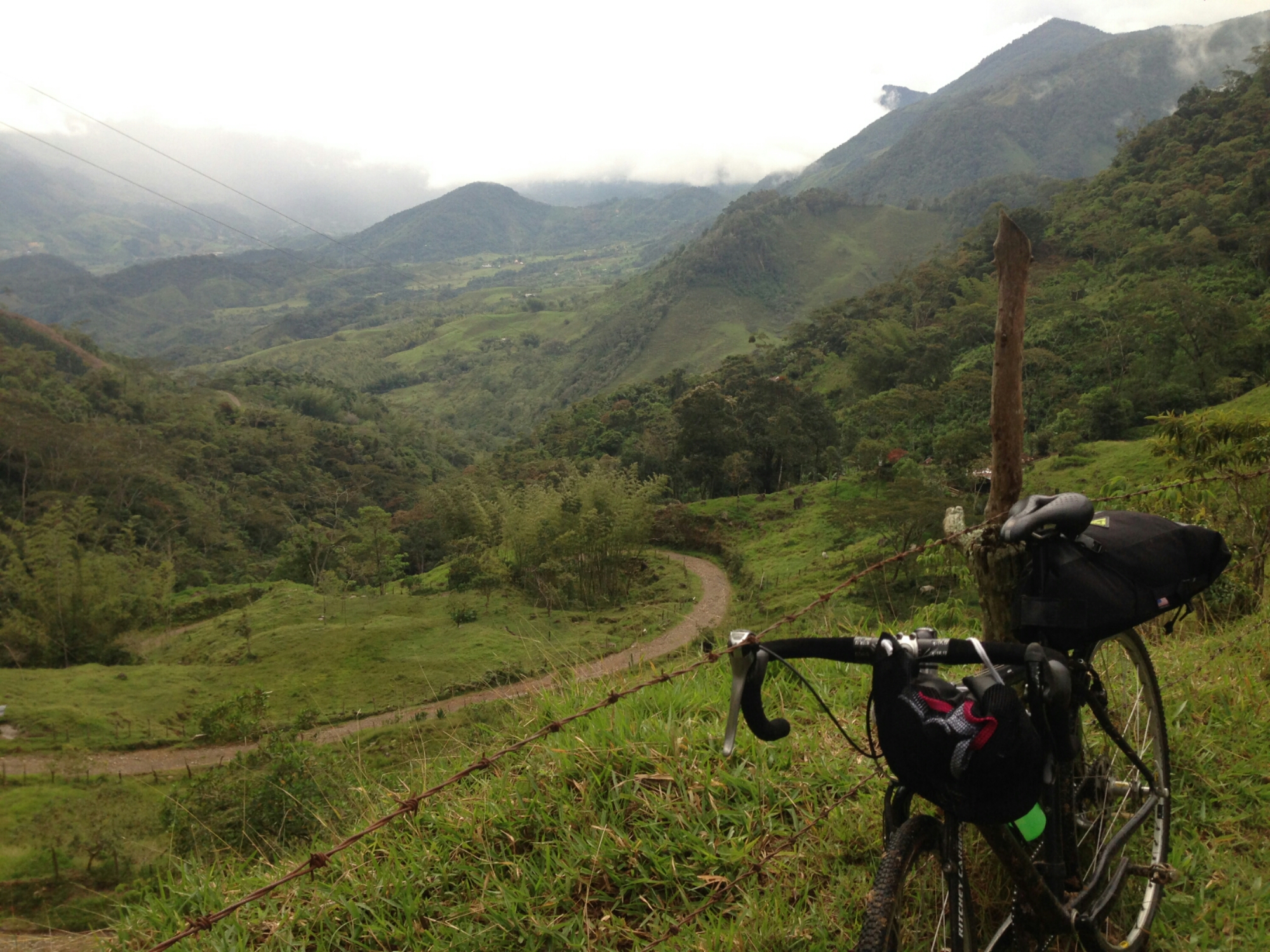
View from the top of the mountain before walking down in the dark
We had just made it to the high point of the road, but we still had about 5 miles to descend on that road before going up again to where Paola’s finca was. The sun was just about to set, and we had barely gone 7 miles from San Raphael. We started walking down the mountain as it grew darker by the minute. To make matters worse, the seatpost bag I was using to carry half of my stuff broke, and I had to carry it on my shoulder. We walked on until it was pitch black before turning on our headlights, which only illuminated the thick fog and the occasional frog hopping across our path.
At the bottom of the road, we came to the junction of Vallejuelo, where two people were sitting outside of a house. One of these people had a truck, and he offered to drive us the rest of the way to Paola’s finca. Paola had also phoned someone to help us get there, but he only had a moto. This guy showed up to the house where we were and joined to show us the way. We piled all of our belongings into the back of the pickup truck and climbed in for the ride. I was astounded by the condition of the road, and I felt guilty for the guy who was taking his truck over such damaging terrain on our behalf, but he didn’t seem to mind. The rocks were huge, potholes even bigger, and we were going up a pretty steep hill the entire way. In the darkness, it felt more gnarly than my rockiest mountain bike ride. We stopped at a small tienda where we could keep our bikes safe on the way up, and then continued on up until we got to a fence. Paola’s friend got out and opened the gate for us, and the truck turned to drive through a muddy field to another gate. Beyond this gate was the house. I was skeptical that the truck would make it back up and out of the mud, but we didn’t stick around to watch them leave.


 Nomadic Cycling