Monthly Archives: November 2015
7 Lessons Learned from 4 Years of Nomadic Cycling
Four years ago, I embarked on a journey that permanently changed the course of my life. The journey started as a desire to do something out of the ordinary and as a resistance to the status quo. This journey has taken me throughout the US, from Alaska to Florida. It has forced me out of my comfort zone a million times over and has challenged me to face many of my fears. I have been fortunate enough to make countless friends along the way and find a loving companion, who is just crazy enough to join me in my travels. Four years ago, I left Portland, OR on my bicycle, heading south with not a single plan set in stone – just an openness to experience something new. That journey continues today, and I’d like to share with you a few lessons I’ve learned from my extraordinary life of travel.
 The first few steps might be the hardest, and it never gets easier – Whenever I’m about to embark on a new adventure, it’s the act of taking those first few steps in a tangential direction that are the hardest. The thing that has surprised me the most about this is that in the past four years I don’t think changing course has ever gotten easier. I guess that’s why it’s often those first few steps that make the biggest difference between an ordinary life and an extraordinary life. This principle is probably best summed up in Newton’s first law of motion – an object at rest stays at rest, and an object in motion stays in motion. I still find leaving home to set out on a two-month bicycle tour just as difficult as coming off that bike tour at the end of two months to set-up a new home. The thing that does get easier is the adaption process. The more I put myself outside of my comfort zone, the more tools I gather and the easier time I have to adapting to a new way of life.
Come up with an ‘ABC Plan’ – What’s an ABC Plan you say? Well, this is a little tool that I’ve developed over the years to help me feel more comfortable in taking those first few steps toward my goals. The “A” in ABC is the best case scenario. I imagine the best case scenario for whatever my next adventure is and what actions I will need to take in order to achieve those results. The truth about the “A” is that it often doesn’t require much more input other than getting started. If everything works in my favor, that scenario is usually self-sustaining and doesn’t require anything additional from me.
You might be able to guess now that the “C” in ABC is the worst case scenario. Mentally I can usually come up with at least half a dozen “C” scenarios, and I try to think about what I will need to do to resolve them or at least reduce the risk of them happening. With cycling these scenarios usually involve: getting my bike/panniers/wallet/cell phone stolen, running out of food/water/energy or ending up in a ditch/hospital/graveyard. While these aren’t pleasant things to think about, they will provide you with a much needed back-up plan and risk assessment strategy, which I have found will make you both more likely to survive a “C” scenario and actually downplay any fears you might have going into a new situation.
The “B” in the ABC Plan is the scenario that is most likely to happen. This is the part where I think you gain the most insight. When it comes to cycling this usually involves things like flat tires, broken chains and spokes, and running behind schedule. This part of the planning phase tells you how to pack and plan for things that are most likely to happen and will once again help alleviate any fears that you have going into your next adventure. The great thing about the ABC Plan is that you can use it in almost any area of your life where you have fear, even if you aren’t embarking on some big new adventure. Looking to ask for that promotion, but afraid? Develop an ABC Plan and explore your options. It might not seem like such a big task anymore.
A life of travel ranges from exhilarating to exhausting – I’m not going to lie, I have felt more exhausted, more times in the past four years than I ever remember feeling the 30 years prior. I’m not talking about the kind of exhaustion you get from riding a 100-mile bike ride or running a marathon. That exhaustion usually dissipates in a day or two. I’m talking about the exhaustion felt from life on the road. In the past four years I have moved my home base from New Orleans, LA to Newport, RI to Portland, OR to Skagway, AK to Durango, CO to Providence, RI to where I’m at now…which is looking for my next “home.” It’s not easy living a nomadic lifestyle, but I do have to say that I have been thrilled with the places I’ve been, the people I’ve met and the once-in-a-lifetime experiences I’ve encountered. I have actually looked back on the past four years of my life and thought to myself “I really do lived a charmed existence.” Though it is rarely easy, it is often rewarding, and that’s why I continue to live this way.
Less really is more – There are so many ways I see this principle apply to my life, and it has truly made me happier. The house with the least possessions is the house that’s the easiest to clean. What I’ve found out about the “less is more” philosophy is that it’s continuing to evolve for me. What I considered traveling light a few years ago is completely different than what I consider it today. I expect that four years from now that idea will have evolved even more. A question pertaining to my nomadic lifestyle that I’m often asked is “Where do you keep all your stuff?” My reply is often as simple as “What stuff?” I’ve learned that I can pretty much find anything I need in just about any town in America, even if I’ve entered that town empty-handed and having no connections. Things like Craigslist, email list-serves and eBay have made it easier than ever to walk into a new place and make a life for oneself. The great thing about the “less is more” philosophy is that it’s going to mean something different to everybody. We will all have different wants and needs. I’ve just found that I’m personally happiest only having to worry about the few possessions that I can carry on either my back or bicycle (and maybe a box or two of nostalgic items that I can keep at a relative’s house), than being bogged down by furnishings of a typical American household. This idea has also led me to purchasing more quality products, often reusing nice used items and focusing on longevity as an economic strategy.
Every experience is enhanced when it is shared – Before I met my Sarah three-and-a-half years ago I did most of my traveling alone. I had some great, I’d even say truly amazing experiences while traveling alone, and I encourage everybody to take on solo travel at least once in their life. Never having to compromise on things like where to go, what to do, where to eat or what to see is what tops my list about solo travel. What I’ve found though, in my own experience, is that when you don’t have another person with whom to share those amazing times, you tend to forget just how amazing they were. There is something about reminiscing with another human being about things that keeps those experiences so much more alive in our memories. After all, what’s the use of a life full of experiences if you have nobody to share them with?
What advice would the future version of yourself give you today? – When I find myself at a crossroads or in a moment of fear or uncertainty, it helps me to look to the future and imagine what advice a future version of myself would give me today. The amount of years I usually use is 10 because that’s a number I think of as being close enough to imagine yet far enough away to hold a different perspective. Maybe 5 years or 8 years or 20 years is a better benchmark for you, it doesn’t really matter. The thing about this exercise is that I find it can help even with the small decisions. Should I work out today? Future me says yes. Do I really need to eat this entire box of cookies? Future me says please don’t. Will this $100 be better off in my savings account or buying some new electronic device? Future me says the $100 does more for him in savings than in an electronic device that has been outdated for years. I’ve found that it helps the most with the big questions though. Should I continue working at this job that I hate because of the short-term fear of quitting or should I take a stab at something completely new? Future me says that I will benefit more from trying something new, even if that means failing, than continuing to do the same thing expecting different results. What would the future you have to say about your recent decisions?
All things considered, humanity is alive and well – Whenever I’ve found myself in a truly tough situation, I’ve found that there was a person there that was willing to help. In fact, something I’ve often said is that if I ever lose my faith in humanity, the best thing I can do is go on a bicycle tour. There’s something about cycling in particular that really seems to bring people together. With websites like WarmShowers and CouchSurfing, connecting with like-minded strangers has never been easier. These websites take away a lot of the fear of meeting new people too, because they require identification verification and you can read what others have to say about these people. I’ve also been shown such beautiful acts of unexpected kindness while bike touring. I’ve had complete strangers offer me a place to stay, buy me dinner, give me money and donate to charities that I support. One of the most touching acts of kindness I’ve experienced came at one of the lowest points in my years of bicycle touring – right after Sarah and I had our bikes stolen. Unbeknownst to us, some friends of ours reached out to strangers, friends and acquaintances and pooled together enough money to allow us to continue on with our travels. At my lowest point, I was shown the most amount of love.
 As I continue on my journey through life, I understand that this list is not exhaustive and is just a drop in the bucket of lessons to be learned. What I’m hoping to show you is that a major life overhaul is possible, and it doesn’t have to be as scary as we humans tend to make it out to be. Even failures, if done in a thoughtful way, can be insightful steps in the right direction. While my ideal life right now is that of a nomadic one, I know that this too can and will change. I’m not recommending that everybody jump on a bicycle and ride across the country, but I do think that everybody can benefit from a little more adventure in their lives, whether that means taking your kids camping, asking your boss for a raise or simply taking your bike for a ride around the block. Two truths that continue to show up in my life: You’re never going to be as young as you are today, and this is the only life you’re guaranteed…so you better make the most of it.
Growing the sport of cyclocross in Rhode Island
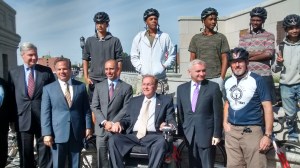
A few teammates attended the opening ceremony for the George Redman Linear Park on the Washington Bridge in September and got a good photo-op with Rhode Island’s most prominent politicians.
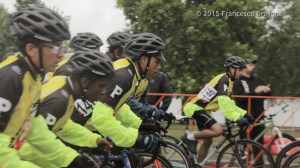
Starting off the first race of the weekend during the KMC Providence Cyclocross Festival.
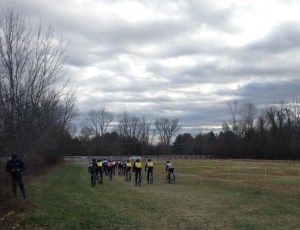
There they go, off the start at Monstah Cross in Walpole, MA!

Practicing shouldering their bikes and running up a steep hill at Roger Williams Park in Providence.
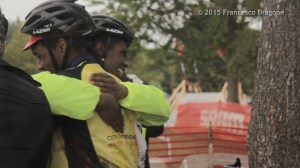 After seeing them in action, I truly think that Ed Raff is a genius for creating this cycling team (either that or he got very lucky). This is a great way to get kids to be active and involved in a team sport that can also double as a mode of transportation and a lifestyle. After most players of team sports like football, rugby or lacrosse have retired due to injury or ‘old’ age, cyclists can maintain their sport for a lifetime. Bicycling has been predominantly a poor person’s mode of transportation but a rich person’s sport, and it’s about time that changes.
Review of Green Guru’s Hauler Bike Pack Saddle Bag

Taking my Green Guru bags out for a test ride on Marshall Mesa in Boulder, CO
During our travels this summer, Dallas and I were lucky to meet a few of the good folks from Green Guru, an awesome company out of Boulder that up-cycles old bike tubes and tent fabrics to make useful things like wallets, backpacks and panniers. We applied to be ambassadors after talking with them at RAGBRAI, and at the end of our season we got to check out their shop in Boulder and receive some gear to test out. I’m writing my first review of the Hauler Bike Pack Saddle Bag in total honesty.
Here are all of the positive features. This bag is like an over-sized saddle pack that attaches to the rails on the underside of your saddle by a clipped strap on each side, and a Velcro strap to secure it to the seat post. The best thing about this bag is there is no need for a rack, so it can literally attach to any bike. At 425 cubic inches of space, you can pack enough stuff in there for an overnight trip if you needed. This pack is made of up-cycled tent fabric
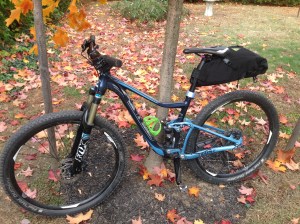
The Hauler Bike Pack looks great on my mountain bike!
and bike tubes on the outside with a waterproof nylon inner lining. It has a reflective strap that faces back towards car headlights when it’s on your bike. This strap is sewn into the bag as a series of loops, and a bike tail light can easily be clipped onto one of the loops. Also on the outside of the bag is a small zippered pocket on the top and a Velcro pocket on the bottom containing a removable plastic stiffener. It has a Velcro and roll-top closure, with 2 more clipped straps to keep it tightly rolled while riding. There’s also a removable, adjustable strap that clips onto the bag easily to convert it into a shoulder bag, or pannier-shaped messenger bag. It’s pretty versatile.
Now for the things that I don’t like about the bag. It can take a while to attach to the saddle, especially if your saddle is mounted all the way forward on its rails. The female half of the clip needs to be fed through the rails, and the bulk of the plastic can be tricky to get through and hold there while you try to bring the male half of the clip to meet it. I know in order to be able to tighten the straps down so the bag isn’t hanging low and loosely between the saddle and rear wheel the strap that is fixed to the bag needs to be short, but maybe the other strap could be longer to make this easier (or there could be a loop attached to the end of that strap so it’s easier to grab to tighten after you’ve loosed the clip all the way). The clips could also be smaller, but then you may sacrifice weight capacity for the bag. The only other thing that is annoying about the bag is riding with it. The bag swings back and forth when pedaling, and I don’t think it is avoidable. Maybe it’s my massive hamstrings that hit the side of the bag with each pedal stroke, batting it back and forth like a pendulum, creating some weird gyroscopic feeling while riding with a heavy load. I’ve tried using the bag with both my mountain bike and road bike, and still get this swinging. However, it’s much better than riding with a backpack! I’ve tested it on the road and on trails, and it’s actually less noticeable on trails, perhaps because the terrain is already bumpy and pedaling isn’t as frequent and rhythmic.
Overall, I am very happy with the Bike Pack Saddle Bag. I look forward to taking it on more long mountain bike rides, and using it to commute around town (although I’m going to have to add to my collection of bike packing bags if I want to take my tent with me). I don’t have a rack on any of my bikes right now, so I haven’t been able to use panniers, and this bag offers a solution, allowing me to carry everything I need without having to wear a sweaty backpack.
Fighting ALS for our friend Bobby
When I first started this website, I wanted to use it to raise money for charity as well as awareness about bicycle transportation and bike advocacy. Since I hate to ask for money, I haven’t been very good at raising it. However, right now our good friend, Bobby Forster, really needs our help. He was diagnosed with ALS just last Christmas, and what started last year as some weakness in one of his arms has progressed way too rapidly to almost total paralysis. It is painful to see our friend, who just a few months ago was riding bikes with his friends and driving pedicabs, in such a helpless state. He has had to buy a special wheelchair, a wheelchair-accessible van to get around, and hire a full-time caretaker. He also has a feeding tube and will eventually need a tracheotomy. Since he obviously can no longer work, Bobby and his family need as much support as they can get to keep living and fighting this horrible disease. If you can spare anything (even as little as $5), please donate to his fund here.
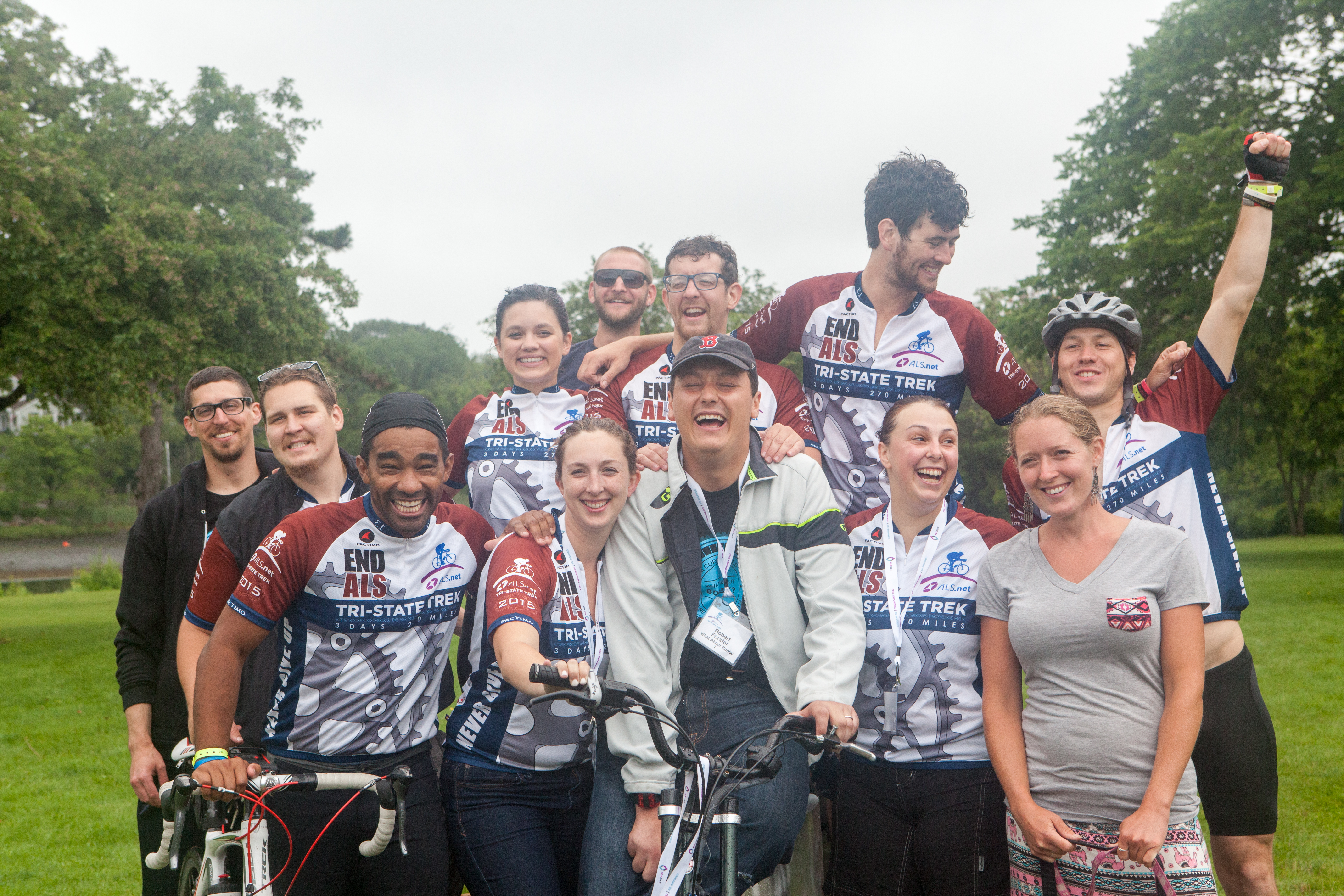
Always smiling, Bobby (in the Sox cap) is surrounded by amazing friends who participated in ALS-TDI’s Tri-State Trek bike tour this summer to raise money for ALS research.
I met Bobby when I became a pedicab driver in Newport, and I worked with him again in New Orleans. He is one of the most positive, welcoming and friendliest people I know, and he’s the main reason why I ended up pedicabbing in New Orleans. I can’t picture Bobby without having a smile on his face. He’s also an incredibly active person, into sailing as well as cycling, so I can only imagine how difficult it is to have his ability to stay so active taken away like this. You can read his story and find out more about ALS through that link, and you can also read Bobby’s updates to his own blog at www.acureforforster.com.
One last thing – If you want to directly fund research for finding a cure for ALS, you can simply text “ALS” to 80077, and you will magically donate $10 to ALS-TDI, an organization that has been working tirelessly since 1999 to search for a cure or treatment.
Closing our PeopleForBikes Season and Looking Ahead
While we’ve taken a hiatus from writing to our NomadicCycling blog, we have been busy traveling, writing and posting to social media for PeopleForBikes. In case you didn’t follow our blogs for PeopleForBikes, you can find most of them at the following links (there were two that didn’t make the cut to get published):
- May – Seasoned riders learn new tricks
- June – Bike trail development makes better communities
- July – What’s in North Dakota?
- August – A visit to a velodrome
- October – Confessions of a traveling duo
We had the experience of a lifetime traveling around the country in the name of bicycle advocacy, and we feel honored to have been able to work on making a difference in the political climate for cycling in the United States. There were definitely some places that were discouraging, but the majority of people we talked to were supportive of bicycling and wanted to see more bike infrastructure in their cities. While living out of a car for six and a half months was definitely stressful on our relationship, we would do it again in a heartbeat if offered the opportunity.
The best part about our short job was getting to network and meet so many people in the bicycling world. Not only did we get to make some awesome new friends, but we were able to visit old friends and family all over the country that we hadn’t seen in months, or years. We visited over 70 bike shops, mostly on the eastern half of the US, and really felt that we were able to connect with some of them to improve cycling conditions for them locally.
The second best part about the job is that we got new mountain bikes from Giant/Liv, and we got to take them to some of the best trails in each of the states that we drove through! We didn’t get to do quite as much riding as we wanted to, but we did get to go to places that we never would have otherwise. Now that we’ve surrendered our car, we’re not sure we’ll get to use the mountain bikes that much, sadly.
Since our contract ended at the end of October, Dallas and I are taking some time off to relax and make up for all the long days we spent on the road with no down time. I’m trying to focus on the remainder of the cyclocross season, and we’re both hoping to go somewhere warm (South America?) for the winter. In the meantime, Dallas is in Portland and I am in Providence until further notice! Also, follow us on instagram for photos! (I’m too lazy to include any in this post right now)


 Nomadic Cycling