Monthly Archives: November 2017
Necoclí to Arboletes
19 November 2017
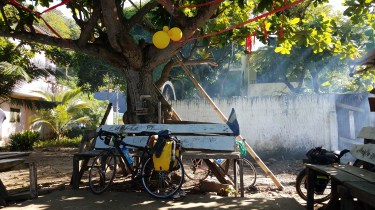
We spent a good amount of time hanging out here, between the village and the beach, cleaning, cooking and eating fish with other biciviajeros.
Despite our best intentions to get an early start that morning, Lenin and I ended up leaving Necoclí well after noon. The other bicycle travelers who had generously hosted us under someone else’s roof invited us to share the fish that they had caught the day before for breakfast. It was being stored in somebody’s fridge just a few blocks away, so we packed up our belongings and biked over to where there was a little hut and barbecue set up on the beach. This ended up taking a good chunk of our morning, as we helped to clean all of the fish that they had. The fish were much too small to be kept legally, and I felt so guilty eating them, but they were already dead, so there was not much I could do. While cleaning and preparing them, we did try to explain that the fish were way too small, hoping that they would release such young fish in the future. We each ate maybe three small fish of various species, accompanied by fried plantains, before continuing our journey along the coast.
Traveling by bicycle is a unique experience, invoking all sorts of reactions from people. Most are in disbelief when you tell them you are traveling by bicycle, to the point where they are not convinced until you confirm what they thought they heard you say at least two or three times and follow up with interesting stories to prove that you are serious, albeit crazy. On the other hand, you become privy to a whole network of like-minded people who you never knew existed before you dove into this lifestyle choice yourself. I never would have met Lenin (or Dallas) had I not made the decision to jump off the ledge of a typical American career path to ride my bike instead. Now it seems as though people of similar mindset are everywhere I go. That morning as we sat around the fire eating fish on the beach with the other bike travelers, we were approached by a few people who were interested in our adventures, probing us with questions. One group of 3 people walked over to us with a clipboard, obviously working for the city. They were surveying tourists and wanted to ask about our stay in Necoclí. We answered to the best of our abilities, but our situation couldn’t really be applied to the typical tourist (we didn’t stay in a hotel, didn’t spend money, etc). When people do find out what we’re doing, most people want to help in some way, which normally takes the form of advice against doing whatever we were planning to do, or warnings about the dangerous roads up ahead. Advice must be taken with a grain of salt, since most of these people would never consider riding a bicycle that far in general, let alone between different towns and countries. Anyway, the general consensus of the people we spoke with that morning told us to steer clear of the scenic coastal road and take the shorter main road that cut inland.
As we got a late start, we were pedaling through the heat of the afternoon sun the entire time. We stopped for dinner at a small town called San Juan de Urabá, just 20 km outside of Arboletes. While dining on fish at this restaurant, a man and woman with a German Shepherd puppy came and sat at the table next to ours. The man was local, and the woman was his sister, who had just moved back to Colombia after retiring from a career in the US agricultural industry. Sadly, I only remember the name of the woman’s dog, Trotski. We spoke to them for a while after we finished dinner, and the man paid for two rounds of beer plus our dinner! Before departing, we got the woman’s contact info so we could reach out when we passed through Montería, the city where she had just purchased her retirement home.

Posing at the beach as a huge wave crashes over the rocks behind me
We departed San Juan de Urabá with a sense of urgency to arrive in Arboletes before the setting sun, and we made very good time over these last 20 kilometers. We arrived at the local beach just in time to witness the sunset on the horizon, and we shared a papaya that we had plucked from a roadside tree. Arboletes has another volcano that is open to the public for bathing in the mud, just a few kilometers outside of town along the road towards Montería. Lenin and I asked some police officers about camping there, and they unanimously recommended against that, saying that it may be dangerous. We decided to check it out anyway.

Leaving the beach of Arboletes just after sunset to find the vulcan de lodo
Darkness sets in pretty quickly after sunset, although it was only around 7pm when we arrived at the volcano. It was difficult to see anything, but there was a small house where the mayordomo (caretaker) lived with his family. A heavyset woman with rich, black skin was lounging on the porch in front of the door, and two kids were playing outside around the entryway. We walked up and asked if we could string our hammocks up under the pavilion next to the volcano for the night. She told us it was technically not allowed, but if we got everything cleaned out before it opened for visitors, we should be fine. This ended up being my favorite place that we slept during the whole trip. It was wonderfully dark and quiet, with only the periodic sound of the sulfur gas bubbling up from the center of the mud-filled crater, less than a hundred meters away. As we were setting up our hammocks, the kids brought over some food that the woman had cooked for dinner. We were fed very well, without even asking, and I was touched by the generosity of this humble family. That day I learned that you can’t always trust the cops, but the locals are generally overwhelmingly welcoming and eager to help.
Turbo to Necocli
18 November 2017

I almost kitten-napped this little guy from Tata’s house.
Lenin and I left Tata’s place just after breakfast, reriding the last several kilometers back into Turbo to collect our helmets, which we had forgotten at Tata’s market. The ride out of Turbo was uneventful aside from a flat tire and a short stop to eat fruit at a finca along the road. We stopped again for fresh juice just outside of Necocli, in El Totumo. I didn’t think it was possible, but there were still fruits I hadn’t ever heard of that Colombians eat or use to make juice, and I tried two more of them at that fruit stand.

This thing was bubbling constantly. Inviting, isn’t it?
Eventually we did make it to the volcano, which resembled a small pit of filthy, boiling concrete. I thought Lenin was out of his mind if he expected us to put our bodies in that thing. I stood there, watching, as Lenin undressed and slowly lowered himself into the mud. Seriously? I could see garbage floating among the dried leaves on the edge of the pit, and it smelled like sulfur. I didn’t care what healing properties it supposedly had. I could not imagine touching the mud, let alone immersing myself in it. Somehow, Lenin coerced me into joining him. The mud was much denser and cooler than it appeared, and it was difficult to get my legs to sink. I didn’t want to let my legs sink. Every little bit of debris, which Lenin assured me was nothing more than dried leaves, creeped me out. I had trouble relaxing, while Lenin was having the time of his life, rolling around, smearing mud all over his face and posing for selfies. This place was totally isolated, and we didn’t see a single person while we were out there. There was also no fresh water to rinse off after climbing out of the volcano. We had to walk back along the muddy trail, covered in thick grey mud.

The cows line up to stare at us. No manners, these creatures have.
On our way back, I felt all of the cows were watching us. They lined up in groups, just staring at us as we walked. It was great fun to scare them all at once and watch them simultaneously take off running. When we reached our bikes, the two bags that we hadn’t bothered to leave in the stables had been opened, and it was clear that someone had rifled through everything. Nothing appeared to have been missing, except for our phone chargers, which we later discovered we had left at Tata’s house. We made it back to the stables and used a hose to rinse off and wash our clothes before heading into Necocli to find a place to spend the night.

Sunset on the beach in Necocli.
We headed straight for the beach in Necocli and watched the sun set into the sea before going into the main town square to eat. While we were in the plaza, a bohemian guy selling handcrafted jewelry off his bicycle approached us and invited us to come pitch our hammocks in the place where he was staying with another bike traveler. We followed him to what looked like an open air restaurant, situated directly across from the beach. It was quiet and dark, and it offered a roof over our heads while we slept. Both bike travelers were Colombian, and one of them claimed to know the owner of the restaurant who let them stay there. The guy who was already in his hammock was suspiciously friendly and kept repeating to us how welcome we were, but Lenin assured me that he was just drunk. The other guy soon went back into town to continue selling his jewelry, and we fell asleep.
Chigorodó to Turbo
17 November 2017

The road was basically like this the whole day.
The road from Chigorodó was totally flat, plus, we had a tailwind, so we really had no excuse to be going so slowly except that it was our first day back to touring on loaded bikes. We did decide to stop and visit a banana plantation, which set us back a few hours.

One of the many roadside stands selling handmade bags, hammocks, drinks and snacks
Uraba is dense with banana and plantain trees, and for a good portion of our ride, we had been passing these plantations. After passing so many, Lenin stopped to talk to some kids on the side of the road, and they agreed to show us one of the plantations. We walked with them across the street and started down a long dirt road surrounded by rows of banana trees.

One of the boys tries to help by pushing my bike through the mud.
This walk definitely brought our average pace down, but it was worth it. After walking for maybe a mile, we turned off the road and onto a narrow trail between more rows of trees. We even had to cross a few streams, carefully balancing with our bikes over skinny planks of cement. Running along the row of trees was an overhead track, that was part of a network of tracks connecting all of the rows and aisles throughout the plantation. We finally arrived at the processing plant, where a huge conveyor belt was rising up and dropping bunches of green bananas onto a mountain of more bananas. Apparently, these were the rejects that were not fit for exportation but would be sold to Colombians.
We observed the entire process of banana processing, from the branches that get pulled along the tracks to the last conveyor belt that carries the boxes of cleaned, cut and stickered banana bunches into the trucks that would haul them away for exportation. The factory workers even let us try pulling the stalks that arrived in waves from somewhere within the plantation. The tracks all converged back at the factory, and bananas could be coming from as far as 2 or 3 kilometers. From there, they were cut into manageable bunches of 5 or 6 bananas and dropped into an enormous vat of water to be cleaned. They floated across the water vat to the workers who would support out which ones were good enough and which were the rejects for the concept belt I had seen when we first arrived. The good ones get dropped into another water bath, floating over to more workers who put stickers on them and add them to plastic bins on another conveyor belt. Each bin pauses for a few seconds while the conveyor belt takes them under a glass box where they get misted with a mineral that prevents them from ripening too quickly. Then the conveyor belt continues and the bananas get transferred from plastic bins to cardboard boxes, which get loaded into the waiting trucks. The bananas we watched were bound for Europe. Before leaving, we gave some money to the boys who had led us to the factory.
Back on the road, we didn’t get very far before it started raining, and we ducked under the cover of a furniture maker that happened to be along the side of the road at the time. They were making bed frames, tables and chairs out of teak, which is another common crop of the region.
We had only completed 38 miles before stopping in Turbo, a port that is projected to grow to be one of the country’s largest, due to its proximity to Medellín. Shortly after arriving in town, a friend of Lenin’s from Uramita pulled up on the back of a motorcycle and greeted him. We followed Tata to her grocery store, where she led us into a small, air conditioned office and had one of her employees bring us fresh juice. Shortly after, Tata drove us to a restaurant near the port so we could share lunch. Fish is plentiful and cheap in this region, and we would eat it nearly every day while touring along the coast.
Back at the grocery store, Tata invited us to stay the night at her house, so we loaded our bikes into her pickup truck and rode with her in the direction from where we came, backtracking several kilometers. On the way to her house, Tata pulled in front of a butcher shop and started ordering meat, calling out over the blaring music to the butcher from her window. After several exchanges of meats and money, we were off to her house.
Tata lives in a nice house outside of Turbo with her three kids, her sister, and two women hired to clean and cook. Her husband has been in prison for the past two years, and Tata was preparing to visit him the following morning. I helped her and her sister pack basic dry goods like oats, coffee, sugar, and crackers into clear plastic bags to bring to the prison. Tata goes to visit every week, but this week she had another family member joining her, so she could bring an extra portion of all of the food she usually brings for her husband. The extra bags would be for her husband’s cell mate so he doesn’t have to share half of his food. While their family doesn’t live too far away distance-wise, their family rarely ever goes out of their way to visit them in Turbo, so sadly, Tata is normally her husband’s sole visitor.
Another Colombian bike tour begins
8-16 November 2017
After a busy summer of working on bikes in Newport and playing trombone with What Cheer? Brigade, I reluctantly left New England midway through cyclocross season to return to Medellin with Lenin. Two days later, we had secured a ride with his brother, Edwin, to Uramita. Within hours of this decision, our bikes were tied onto the roof of Edwin’s van, and all of our belongings were packed inside as we journeyed in the night along with 6 other family members through the mountains to their home pueblo, 3 or 4 hours away.
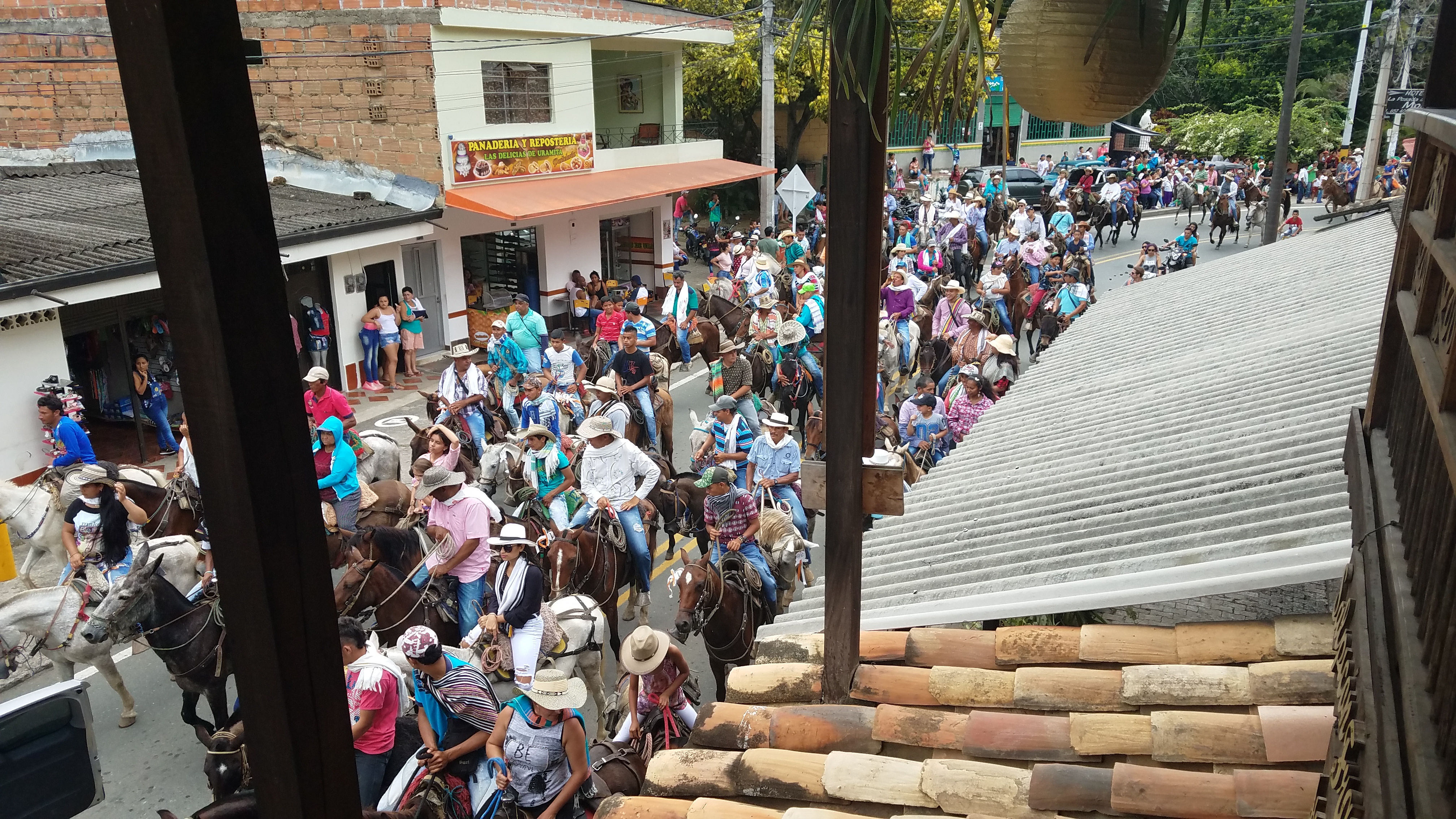
Part of the Fiesta del Campesino involves a parade of people on horses.
We arrived around 1 in the morning, but the town was in the midst of a lively fiesta, despite heavy rain showers. This weekend Uramita was celebrating Fiesta del Campesino, a party that happens once every two years for the farmers and involves dancing to live vallenato music until sunrise.

Lenin skates for the first time at the track in Uramita, nestled in the mountains.
Exhausted, I just wanted to sleep. We spent the next few days talking to people, playing tennis, inline skating, and immersing ourselves in the community. One day we cycled to Frontino, a town just 25km away, but mostly uphill. We returned later that day to begin organizing our gear for another bike tour.
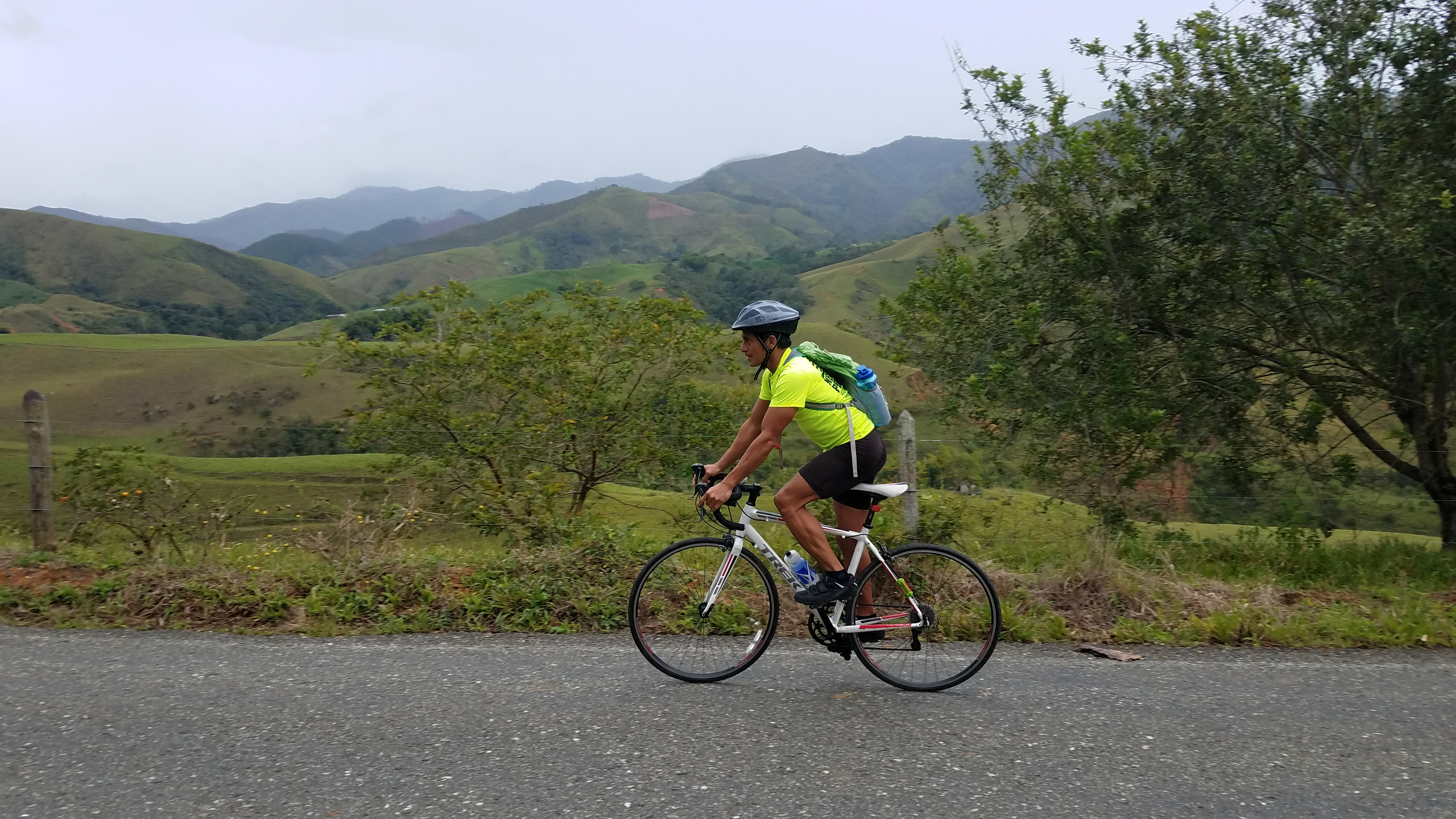
Biking to Frontino from Uramita.
Lenin had wanted to bike from Medellín to Uramita, but we ended up riding with Edwin to save time. Similarly, we were hoping to ride all the way to the coast, but we ended up hitching a ride on a bus that one of Lenin’s many cousins operates between Medellin and Turbo. We were missing a part for the rear bike rack, and we wanted to get another rack to install on the other bicycle, both of which were impossible to find in Uramita. The bus left us in Chigorodó, where we stayed with Lenin’s aunt for a day.
Chigorodó is part of Uraba, a region of Antioquia that stretches from Dabeiba to the border with Cordoba, and it is full of cyclists. People of all ages and on all types of bicycles constantly ride up and down the main road through the town, often carrying another person on the handlebars or top tube. It is not uncommon to see entire families balancing on a single bicycle, or someone using their bicycle to carry a large or heavy item such as furniture or a ladder. This was the perfect place to find the last few things we needed for our tour.


 Nomadic Cycling